
Your Garden Is a Bio-diverse Community Landscape
What if we told you that your backyard could feed your family, shelter pollinators, clean the air, and look absolutely gorgeous — all at the same time? At Deep Roots Project, we believe that growing food and growing biodiversity aren't competing goals. They're the same goal. Let's dig in.

Edible Landscapes, Companion Planting,
and the Beauty of Biodiversity
This isn't garden fantasy. It's the quiet wisdom of edible landscaping: the art of weaving food-producing plants into a living, breathing ecosystem that works with nature rather than against it. When we stop thinking of our gardens as rows of crops to be managed and start thinking of them as communities of interdependent life, everything changes — the soil, the harvest, and even the way we see our relationship with the land.
Start Where Life Starts: The Soil
Before a single seed goes in the ground, the real work is already happening beneath your feet.
A single handful of healthy garden soil contains more microorganisms than there are people on Earth. Bacteria, fungi, nematodes, earthworms, and microscopic arthropods form a vast underground web — decomposing fallen leaves, breaking down organic matter, and converting it into exactly the nutrients your plants need. This isn't magic. It's microbiology, and it's extraordinary.
Healthy soil is the non-negotiable foundation of any edible landscape. Without it, you're not really gardening — you're just propping plants up with chemicals and hope. With it, your garden becomes self-sustaining, resilient, and generous.
How to nurture your soil:
Compost, compost, compost. Return organic matter to the earth. Kitchen scraps, fallen leaves, spent plants — they all have a second life as soil food.
Avoid tilling. Tilling disrupts the fungal networks (mycelium) that quietly shuttle nutrients between plant roots.
Mulch heavily. A thick layer of wood chips or straw mimics the forest floor, retaining moisture, suppressing weeds, and feeding the microbiome beneath.
Plant cover crops like clover or buckwheat in the off-season to protect and enrich bare soil.
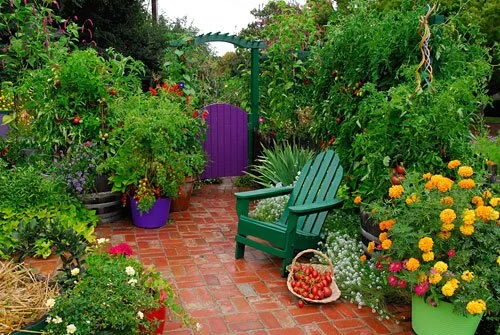
The Power of Companion Planting:
Plants as Neighbors, Not Strangers
In nature, plants don't grow in monocultures. A forest isn't a field of oak trees. A prairie isn't wall-to-wall switchgrass. Diversity is nature's default — and there's a very good reason for that.
Companion planting is the practice of deliberately placing plants together so they support, protect, and nourish one another. It's one of the oldest agricultural techniques in the world, used for thousands of years by Indigenous farmers across the Americas, Asia, and Africa — and modern science is finally catching up to what those farmers always knew.
The Three Sisters: An Ancient Blueprint
Perhaps the most celebrated companion planting system is the Three Sisters — corn, beans, and squash — grown together by many Indigenous peoples of North America for millennia. Each plant plays a distinct role:
Corn grows tall, providing a natural trellis for beans to climb.
Beans are nitrogen-fixers, pulling nitrogen from the air and depositing it into the soil where the corn and squash can use it.
Squash sprawls along the ground, its broad leaves shading the soil, locking in moisture, and crowding out weeds.
Three plants. Three roles. One thriving system. No synthetic fertilizer required.
Companion Planting Combinations to Try
Tomatoes + Basil: Basil is said to repel aphids, whiteflies, and tomato hornworms, while improving the flavor of the fruit growing beside it. Plus, you'll always have fresh basil for your Caprese salad.
Roses or fruit trees + Garlic/Chives: Alliums deter aphids and other soft-bodied pests and can help prevent fungal diseases in nearby plants.
Brassicas (cabbage, kale, broccoli) + Nasturtiums: Nasturtiums act as a "trap crop," luring aphids away from your brassicas. Bonus: nasturtium flowers are edible and add a peppery zip to salads.
Carrots + Rosemary or Sage: These aromatic herbs confuse and deter the carrot fly, one of the most common carrot pests.
Cucumbers + Dill: Dill attracts beneficial predatory wasps that feast on cucumber beetles and aphids.
Beans + Potatoes: Beans repel the Colorado potato beetle; potatoes repel the Mexican bean beetle. They look out for each other.
The principle underlying all of these is simple: diversity confuses pests, attracts predators, and builds resilience. A garden of many species is far harder for any single insect or disease to devastate than a mono-culture.
Invite the Good Bugs:
Beneficial Insects and Pollinator Habitat
Not all insects are enemies. In fact, most are either neutral or actively beneficial to your garden. The key is building habitat that attracts them.
Beneficial insects include ladybugs, lacewings, hoverflies, parasitic wasps, and ground beetles — all of which prey on the aphids, whiteflies, and caterpillars that damage your plants. If you reach for a pesticide every time you see a bug, you're likely killing these allies along with the pests.
Instead, plant for them. A diverse edible landscape that includes flowering herbs, native perennials, and pollinator-friendly plants will draw beneficial insects naturally.
Plants that attract beneficial insects:
Sweet alyssum — a low-growing annual that blooms prolifically and attracts hoverflies and parasitic wasps
Fennel and dill — umbellifers (flat-topped flower clusters) beloved by beneficial wasps
Borage — beautiful blue star-shaped flowers that attract bees and repel tomato hornworms
Phacelia (baby blue eyes) — one of the best insect plants you may never have heard of
Evening primrose — draws moths and beetles, which in turn attract birds
Yarrow — a tough native perennial that blooms in clusters and hosts dozens of beneficial species
Don't forget: pollinators need water too. A shallow dish of water with pebbles for landing gives bees and butterflies a welcome rest stop.
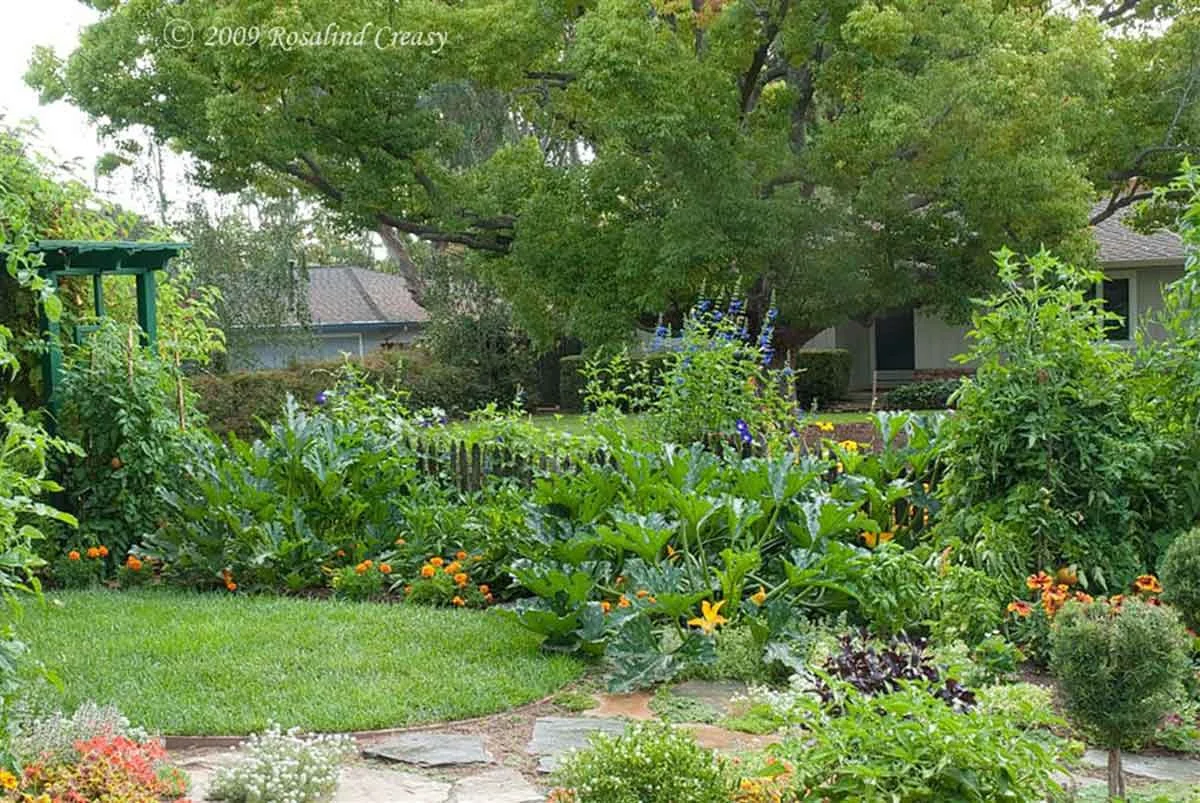
Native Plants: The Heart of a Bio-diverse Garden
Here's a truth that can transform your garden: native plants are not just "nice to have." They are the foundation of local biodiversity.
Native plants evolved alongside your local insects, birds, and soil microbes over thousands of years. They provide the exact nutritional profile, bloom timing, and habitat structure that native wildlife depends on. A non-native ornamental, however beautiful, often functions as an ecological dead zone — visiting insects may find its pollen indigestible, and native birds may find its berries lacking in the fats they need to survive.
Entomologist Doug Tallamy's research has shown that native oak trees alone support over 500 species of caterpillars — which are, in turn, the critical food source for nearly every songbird in North America. By contrast, a Callery pear or Bradford pear — ubiquitous in suburban landscaping — supports fewer than five.
The good news? Native plants are often lower maintenance, more drought-tolerant, and more beautiful than you might expect. Once established, they largely take care of themselves.
Native plants to weave into your edible landscape:
Native ferns for shaded, moist areas — they provide ground cover, habitat, and a lush aesthetic without requiring irrigation or fertilizer
Wild ginger as a shade-tolerant ground cover
Native coneflowers (Echinacea) — medicinal, beautiful, and beloved by goldfinches
Wild bergamot (Monarda) — a native mint relative that feeds bumblebees and makes excellent tea
Serviceberry (Amelanchier) — a native shrub or small tree producing edible berries in spring, beloved by over 40 species of birds
Pawpaw — the largest edible fruit native to North America, with rich, custardy flesh and striking large leaves
Native elderberry (Sambucus canadensis) — produces flowers for elderflower cordial and berries for elderberry syrup, while feeding dozens of bird species
Blend these with your vegetables and fruit trees. A pawpaw tree beside your tomatoes. Coneflowers along the border of your raised beds. Wild bergamot woven between your squash. This is what edible landscaping looks like when it grows up.
Perennials vs. Annuals: Planting for the Long Game
One of the biggest shifts you can make as a food gardener is reducing your reliance on annual vegetables — plants that must be replanted each year — and increasing your edible perennials: plants that return on their own, year after year, building deeper roots, richer soil relationships, and larger harvests over time.
Edible perennials to consider:
Asparagus — takes a couple years to establish, but then produces for 20+ years
Rhubarb — thrives in cold climates and returns faithfully every spring
Chives, sorrel, lovage — low-effort, high-reward culinary herbs that spread gently and never need replanting
Horseradish — plant it once and you'll be fighting to keep it contained (in a good way)
Jerusalem artichoke (sunchoke) — a native sunflower relative that produces masses of edible tubers
Fruit trees and berry bushes — the ultimate perennial investment. A well-placed apple, pear, or fig tree can feed your family for generations.
A garden anchored by perennials requires less labor, produces more stable yields, and builds soil carbon year over year. It's the slow food of garden design.
Designing for Beauty and Function
Edible landscaping doesn't mean sacrificing aesthetics. In fact, some of the most stunning gardens in the world are food gardens. The goal is to think like a designer and a farmer simultaneously.
Think in Layers
A healthy natural ecosystem has vertical layers — canopy, understory, shrub layer, ground cover, and root zone. You can replicate this in your garden:
Canopy: Fruit and nut trees (apple, pear, pecan, persimmon)
Understory: Berry bushes and dwarf fruit trees (currant, gooseberry, dwarf plum)
Herbaceous layer: Vegetables, herbs, and perennial flowers
Ground cover: Strawberries, thyme, clover, native violets
Climbers: Grapes, kiwi, hardy climbing beans trained up trellises, fences, or arbors
This layered approach maximizes your growing space, creates visual depth, and provides habitat for a cascade of wildlife.
Color, Texture, and Flow
Use a color wheel to plan complementary plant combinations. Cool lavenders and blues look stunning against warm oranges and yellows.
Ornamental grasses add texture and movement and remain attractive even in winter when other plants have gone dormant.
Edible flowers — calendula, borage, nasturtium, viola — bridge the gap between beauty and utility. Plant them liberally throughout your beds.
Consider adding hardscape elements — stone paths, brick borders, wooden raised beds — to give your garden structure and make maintenance easier year-round.
Vertical Growing
Even a small yard has more growing space than you think when you look up. Trellises, fences, pergolas, and walls can support cucumbers, melons, squash, beans, peas, and climbing roses. A south-facing wall absorbs heat during the day and radiates it at night, creating a micro-climate that can allow you to grow plants slightly outside your usual range.
The Bigger Picture: Why This All Matters
Every edible landscape is a small act of ecological restoration.
When you plant a serviceberry instead of a Bradford pear, you're feeding birds. When you leave a patch of clover in your lawn, you're feeding bees. When you compost your kitchen scraps, you're closing a loop that industrial food systems have broken wide open. When you grow even a fraction of your own food, you're reducing demand on a supply chain that depletes soil, pollutes waterways, and contributes to climate change.
These aren't small things. Multiplied across neighborhoods, cities, and regions, they are transformative.
The edible landscape is, at its core, a philosophy: that beauty and utility are not opposites, that humans and ecosystems can thrive together, and that the best gardens give far more than they take.
Getting Started: Your First Steps
You don't need to overhaul everything at once. Start small and let your garden evolve.
Assess your light. Know which parts of your yard get full sun (6+ hours), part sun, and shade. This determines everything that follows.
Add one native plant this season. Just one. Notice what visits it.
Try one companion planting pairing. Tomatoes and basil. Squash and nasturtiums. See what happens.
Stop using broad-spectrum pesticides. Give beneficial insects a chance to find your garden and do their work.
Start composting. Even a simple bin in a corner will transform your soil within a year.
Plant something you've never grown before. The learning is part of the joy.
Your garden is waiting to become something more than a patch of vegetables. It's waiting to become a community — of plants that support each other, insects that protect each other, and humans who belong, however humbly, to the wider web of life.
Plant something. Feed something. Protect something.
Deep Roots Project is here for every step of the journey.
“Grow Your Own Food” blog posts
See the full list of our Grow Your Own Food blog posts. Each post is assigned ”tags” which are under the post title. If you need a quick answer to a gardening question give us a call or send a text to our customer support team – support[at]deep-roots-project.org AND 708-655-5299.
Deep Roots online store
See our online store for details about prices, ordering and delivery of raised beds, planter boxes, microbe-rich compost, worm castings, leaf mulch and more. We don’t sell traditional soil, since we use 100% compost as our growing medium. Our online store has 2 sections – (1) raised beds and planter boxes and (2) compost, worm castings, fertilizer.
Please contact our customer support team before placing an order online so we can assist you with the details and answer your gardening questions. You can pay by credit card in the store or by check.
(708) 655-5299 and support[at]deep-roots-project.org
Sign up for our newsletter
Please leave your cell phone number when you sign up for our eNewsletter, if you want text message announcements now and then.
Donations help us provide organic kitchen gardening education to individuals, organizations, and entire communities. Thank you in advance for contributing to our community and for sharing our website and blog with friends and family.