
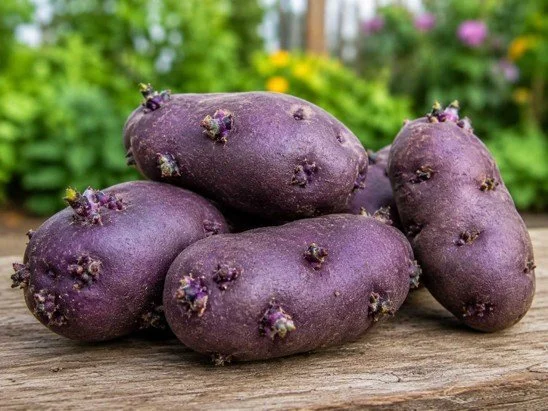
Growing Potatoes
For urban and suburban gardeners, potatoes can feel like a crop that belongs on farms, not patios, side yards, and small backyard beds. But the right variety and the right growing method can turn a few square feet into a surprisingly productive potato patch.
For urban and suburban gardeners, potatoes can feel like a crop that belongs on farms, not patios, side yards, and small backyard beds. But the right variety and the right growing method can turn a few square feet into a surprisingly productive potato patch.The determinate potato method is best for beginners and has smaller harvests. The indeterminate method is great for experienced gardeners and produces a huge harvest in a tiny space.
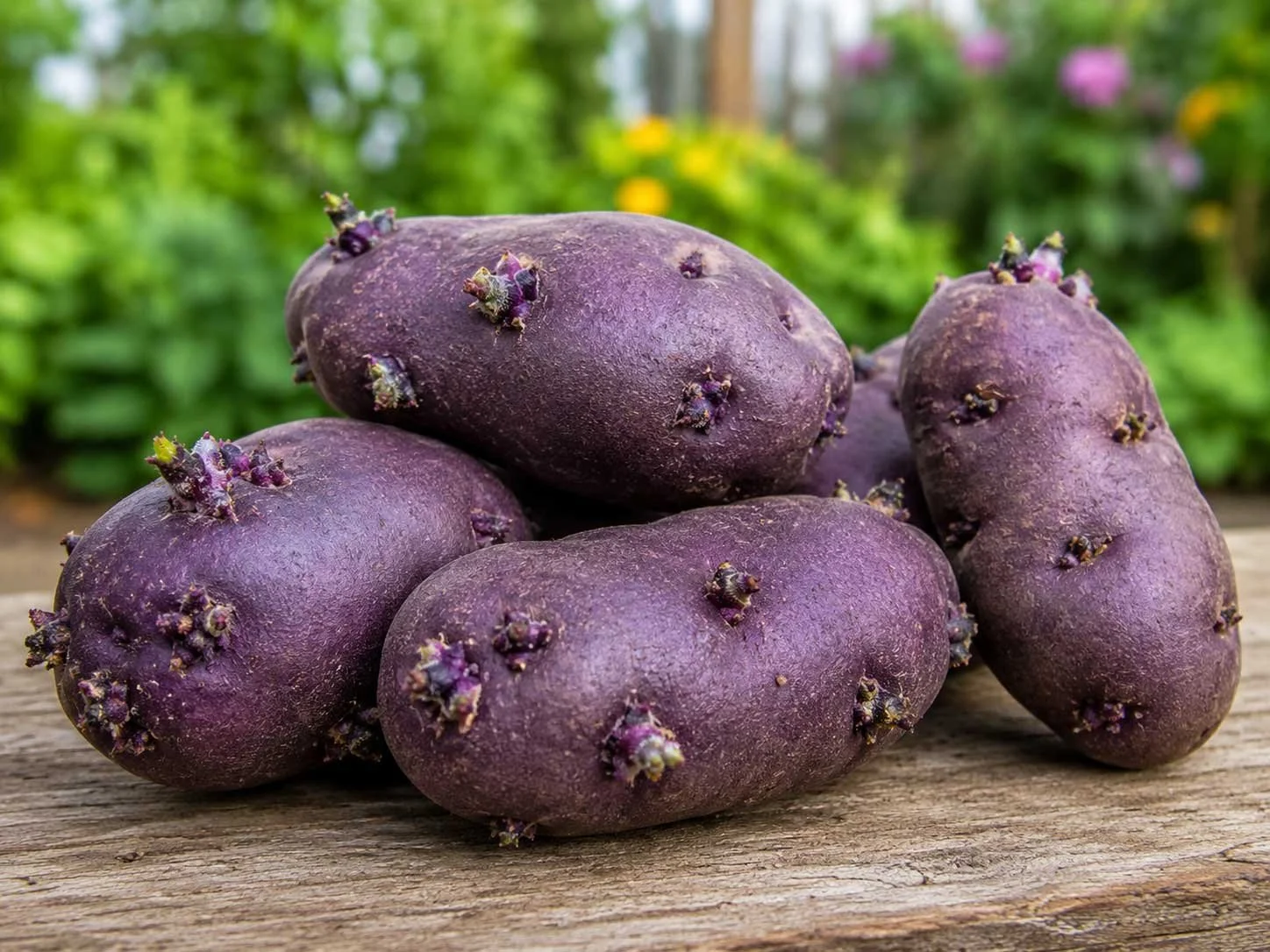
Magic Molly is one of our favorite potatoes
This Deep Roots guide focuses on Magic Molly, a striking purple potato with deep violet skin, richly colored flesh, and the kind of garden-to-table beauty that makes small-space gardening feel abundant.
It’s great for compact gardens because it offers more than novelty. Its purple color comes from anthocyanins, the same family of plant pigments that gives blueberries and eggplants their deep color, and purple potatoes are valued for these antioxidant-rich compounds. Magic Molly also holds its color well when cooked, making it especially fun for roasting, boiling, potato salads, and colorful weeknight meals. Cornell University describes Magic Molly as an extremely vigorous purple-fleshed potato that can be harvested young as “fingerlings” or left longer to size up into larger tubers.
Check Out These Blog Posts As Well
Potatoes & tomatoes are in the nightshade family.
Both potatoes and tomatoes can be determinate or indeterminate. Other nightshade veggies include eggplants, tomatillo, peppers, spices made from nightshade peppers. Both grow from “seed potatoes” instead of from. seeds. The sprout emerges form fuzzy of dark spots called “eyes” on the potato skin, visible in the photo above.
Determinate potato varieties grow as a compact, bush-like plant and reach a fixed mature size. They produce tubers in a single layer at a fixed point along the stem, just below the soil surface. They are often referred to as "early" or "mid-season" potatoes, typically maturing in 70 to 90 days. They require minimal “hilling/mounding” (covering leaves as they grow). While light mounding is recommended to prevent the tubers from turning green due to sunlight exposure, it will not increase the overall yield. No matter how carefully you add layers, determinate potatoes will not take full advantage of the stacked growing space and will have lower yields.
Indeterminate potato varieties are larger, sprawling plants that continue to grow and produce tubers underground along the length of their stems (“stolons”) throughout the season. They need a “stacked grow tower” to accommodate their much larger yield. They require a longer season (110–135 days) and must be continually hilled with soil & straw to cover new leaves for maximum production. Magic Molly purple fingerling potatoes are the Deep Roots favorite indeterminate variety.
Mix the soil blend
Potatoes need loose, fertile, well-drained soil. Hard, compact soil leads to misshapen potatoes, and potatoes need uniform moisture while tubers develop. Blend a loose potato soil mix:
50% high-quality low-nutrient potting soil
30% Deep Roots high-nutrient compost
20% Deep Roots dense leaf mulch
Blend in potassium fertilizer. Mix in a organic potassium fertilizer like Kelp Meal or “Sulfate of Potash” into your lower soil layer to ensure the tubers have food to bulk up later in the season. For a 30-inch diameter grow tower, mix in 1 to 2 cups of kelp meal total. Avoid leaving dense clumps of kelp meal, which can occasionally lock up moisture or concentrate salt.
Prepare certified organic seed potatoes
Conventional grocery store potatoes are not seed potatoes because they lack quality assurance, carry high risks of spreading soil-borne diseases, and are often treated with sprout inhibitors that prevent them from growing. While they look identical, their intended use and production processes differ entirely. Conventional grocery store potatoes are sprayed with chemicals (like chlorpropham) to prevent them from sprouting. If planted, they will likely rot in the ground before they ever grow into a plant. Some organic potatoes are not sprayed and can become seed potatoes if they develop “eyes” in storage. We use the organic potatoes sold at Sugar Beet Coop in Oak Park, IL
Potatoes are “tubers” (underground fruits) that form on underground stems called “stolons.” The "eyes" of a potato are small dormant buds located on the surface of the tuber where new growth begins. The photo above shows the “eyes.” When conditions like warmth and moisture are favorable, the buds in the eyes break dormancy to produce shoots.
These shoots grow upward to become leafy stems above ground, while also developing roots and “stolons” that eventually produce new tubers. The growing shoot fuels its initial development by drawing stored starch from the seed potato until it can photosynthesize on its own.
Chitting: About 5 to 10 days before planting put seed potatoes in a bright room with indirect light. Let them form short, sturdy green sprouts. This is called green sprouting or “chitting.” Do not let them grow long, pale, fragile sprouts.
Cutting the seed potatoes: One to three days before planting leave very small seed potatoes whole. Cut larger seed potatoes into chunks. Make sure every piece has at least one strong eye; two or three is better.
Callusing the seed potatoes: (“scabbing over.”) Place the cut potatoes in clean, dry, ventilated air at room temperature for a few days, with the cut sides exposed so they can dry and form a leathery protective surface. This step helps reduce the risk of rotting once the seed pieces are planted.
Growing determinate potatoes is easier
Determinate potatoes reach maturity faster and are the best choice for gardeners who are planting late in the season or who want the simplest small-space method. Unlike long-season indeterminate potatoes, determinate varieties set most of their tubers in one layer near the base of the plant. That means they do not need a tall stacked tower, and repeated deep hilling will not greatly increase the yield. For these varieties, the goal is simpler – give the plants loose soil, steady moisture, and enough light covering to keep the developing potatoes from turning green.
This matters especially for gardeners planting in late May in Zone 6a. By this point, the best choice is usually a faster-maturing determinate variety such as Yukon Gold, Red Norland, or Dark Red Norland. These varieties have a shorter growing season than late indeterminate potatoes, so they can still produce a useful harvest when planted after the ideal early-spring window. Late planting may produce more “new potatoes” or medium-size potatoes rather than maximum storage-size potatoes, but it is still worthwhile if you plant in late May and keep the soil evenly moist.
A simple no-dig method can be done without a potato tower. Place four seed potato pieces directly on bare soil in a loose cluster about two feet wide. Cover them with about six to eight inches of loose straw. When the shoots grow eight to ten inches tall, add more straw around the stems, leaving several inches of green foliage exposed. Repeat lightly as needed through the season, mainly to keep the tubers covered and protected from sunlight.
Because determinate potatoes do not produce heavily up a long buried stem, this mound does not need to become very tall. A finished mound of about 12 to 18 inches is usually enough. Focus on keeping the straw loose, the soil underneath moist, and the plants growing steadily. In hot weather, check moisture often because straw mounds can dry out quickly.
At harvest, pull the straw apart by hand and gather the potatoes from the soil surface and upper soil layer. This no-dig version may produce less than a tower planted earlier in the season, but it is inexpensive, beginner-friendly, and well suited to late planting. For urban and suburban gardeners, it is one of the easiest ways to grow a dependable potato crop in a small backyard space.
The potato tower method
Vertical potato growing is not magic. It is plant care. It is the experience of growing something unusual, nutritious, and generous in a space that might otherwise seem too small for potatoes at all. Potatoes still need full sun, loose soil, steady moisture, and enough growing medium to support tuber development. A tower can be useful where garden space is limited because it concentrates the crop into a compact footprint, keeps the growing area tidy, and makes harvest easier when the tower is opened at the end of the season.
Planning the DIY potato tower. This stacked vertical growing technique is for late-season indeterminate potatoes. Instead of planting potatoes in long rows, this method grows them upward in a wire tower. The purpose is to keep burying the underground potato stems (stolons) as they grow, giving the plant more covered stem area. This repeated covering encourages tubers to develop at multiple levels inside the tower.
Choose the right potato variety. This method works best with late-season indeterminate potatoes such as Magic Molly, Russet Burbank, Kennebec, Elba, or German Butterball. Avoid determinate varieties like Yukon Gold, Red Norland, and most fingerlings, because they usually set their tubers in one layer near the base of the plant.
Choose a sunny location that receives at least six to eight hours of direct sunlight each day. Potatoes need strong sun to produce healthy foliage and support tuber development. For gardeners in zones 5 through 7, planting is usually done two to three weeks after the last frost, once the soil temperature has reached about 45°F.
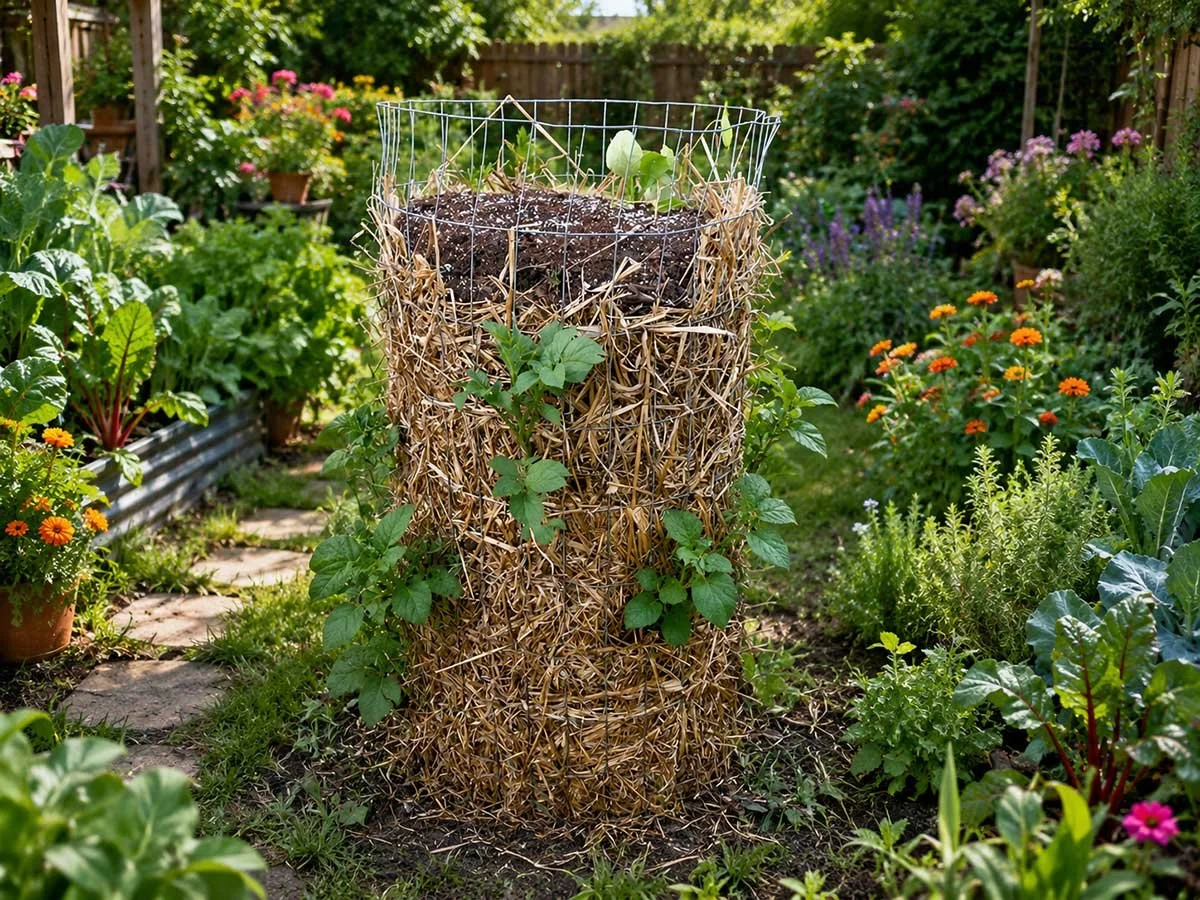
Building the Potato Tower
Choose the wire fencing. Use wire fencing that is 24 to 30 inches tall. Any sturdy wire fencing will work as long as the openings are about 3 by 5 inches. Deep Roots prefers green wire fencing because it blends naturally into the garden.
Cut the fencing to length. For a tower about 30 inches in diameter, cut a piece of fencing about 8 feet long. This will give you enough length to form the circle and overlap the ends slightly for fastening.
Shape the tower. Bend the fencing into a cylinder about 30 inches wide. Stand it upright in the garden where the potatoes will grow.
Secure the ends. Overlap the two ends of the fencing by a few inches and fasten them together with wire ties, zip ties, or short pieces of garden wire.
Check the finished size. The finished tower should be about 24 to 30 inches tall and about 30 inches across. This creates a compact growing space with a footprint of roughly 5 square feet, which is ideal for small-space potato growing.
Drainage is important. The tower should drain freely into the ground. Dig our any weed roots in the ground. A light 1- to 2-inch layer of loose straw at the very bottom is okay, if the tower sits on bare soil. But it should not be packed down or thick enough to block drainage.
Line the tower sides with straw. Line the first 12 inches inside vertical sides of the wire tower with straw, pressing it against the grid to keep the soil blend from spilling out through the wire openings.
Add the first 6” of soil. Add your first 6 inches of loose soil blend to the bottom area.
Add the seed potatoes. Place 10 to 15 seed potato cut-pieces on top of the first 6” of the soil with the eyes facing upward. 10 pieces spread further apart will produce larger potatoes. Space them evenly around the tower.
Add the second 6” layer of soil to cover the seed potatoes .
Water thoroughly. The tower should be evenly moist but not waterlogged.
What is “Hilling”?
Hilling is the heart of the potato tower method. Potatoes grow from underground branches called "stolons." By burying the stems as they grow upward, you trick the plant into producing more stolons, which means a much bigger harvest! Hilling also creates a dark underground environment. This is critical because any developing potatoes exposed to sunlight will turn green and become toxic.
The golden rule: Keep soil and straw in separate layers. In your tower, you will create a "lasagna" of distinct, alternating layers of soil and straw. Do not mix or blend the straw directly into the soil. Mixing straw into active soil causes a "nitrogen tie-up." Soil microorganisms will steal nitrogen from your potato roots just to break down the tough straw. Keeping them in separate layers gives your potatoes a light, fertile base that drains well, holds moisture, and keeps your plants fed.
The mounding schedule. Within one to two weeks of planting, green shoots will begin to emerge. Once they pop up, follow this step-by-step hilling schedule. (1) Wait until the green vines grow 8 inches above the surface. (2) Add another 10 inches of stray lining to the wire gred. (3) Add 4 inches of loose soil around the stems and leaves. (4) Immediately cover that new soil with 3 to 4 inches of loose straw. (5) Always leave the top 2 to 3 inches of green foliage exposed so the plant can breathe and get sunlight. (6) Repeat this alternating process (soil layer, then straw layer) every 2 to 3 weeks whenever the vines grow another 8 inches. (7) Most towers require 3 to 4 layering cycles.
Critical hilling milestones & tips. Straw compresses significantly over time. A loose 12-inch pile of straw will quickly settle into a layer of just a few inches, so don't be afraid to pack the outer edges tightly to block light. Stop adding layers once your tower reaches 2 to 3 feet tall. Indeterminate potato varieties lose growing efficiency if forced to climb any higher than this. Always finish your tower with a thick top layer of straw. This acts as a protective mulch to regulate soil temperature, conserve water and allow the vines to easily push through as they grow. Indeterminate potatoes are ideal for towers because they continuously grow new tubers all the way up the stem. The loose soil layers give the roots room to expand, while the sponge-like straw layers catch water from the top and slowly feed it down to the base of the tower.
Watering is especially important
A grow tower dries out faster. A wire tower filled with straw/soil mix dries out faster than potatoes grown in the ground because air moves around the sides. Check moisture by pushing your finger about three inches into the growing mix. If it feels dry at that depth, water deeply until moisture comes out of the bottom of the tower. In hot summer weather, this may be needed every other day. In cooler or rainy weather, twice a week may be enough.
Stop adding new layers when flowering begins. Flowering signals that tuber formation is already underway, and the plant should now focus its energy on swelling the potatoes it has set. But, continue watering evenly, but do not keep burying the leaves after this point.
After flowering, allow the plants to grow for another four to six weeks, or until the vines begin to yellow and die back naturally. This waiting period allows the potatoes to gain size and helps the skins toughen for better storage.
Avoid harvesting too early,
The final weeks can add meaningful weight to the crop. To harvest, cut the wire ties and unwrap the fencing. The column of straw, compost, and potatoes will collapse onto the ground. Pull the loose material apart by hand and collect the potatoes from each layer. A well-managed first-year tower using the right variety, full sun, and steady watering may produce about forty to sixty pounds from one four-square-foot tower.
Pest and disease watch
Check leaves at least twice a week. Watch for Colorado potato beetle eggs and larvae, Flea beetle feeding, Leafhopper damage, Yellowing, spotting, or early die-back, and chewed stems near soil level.
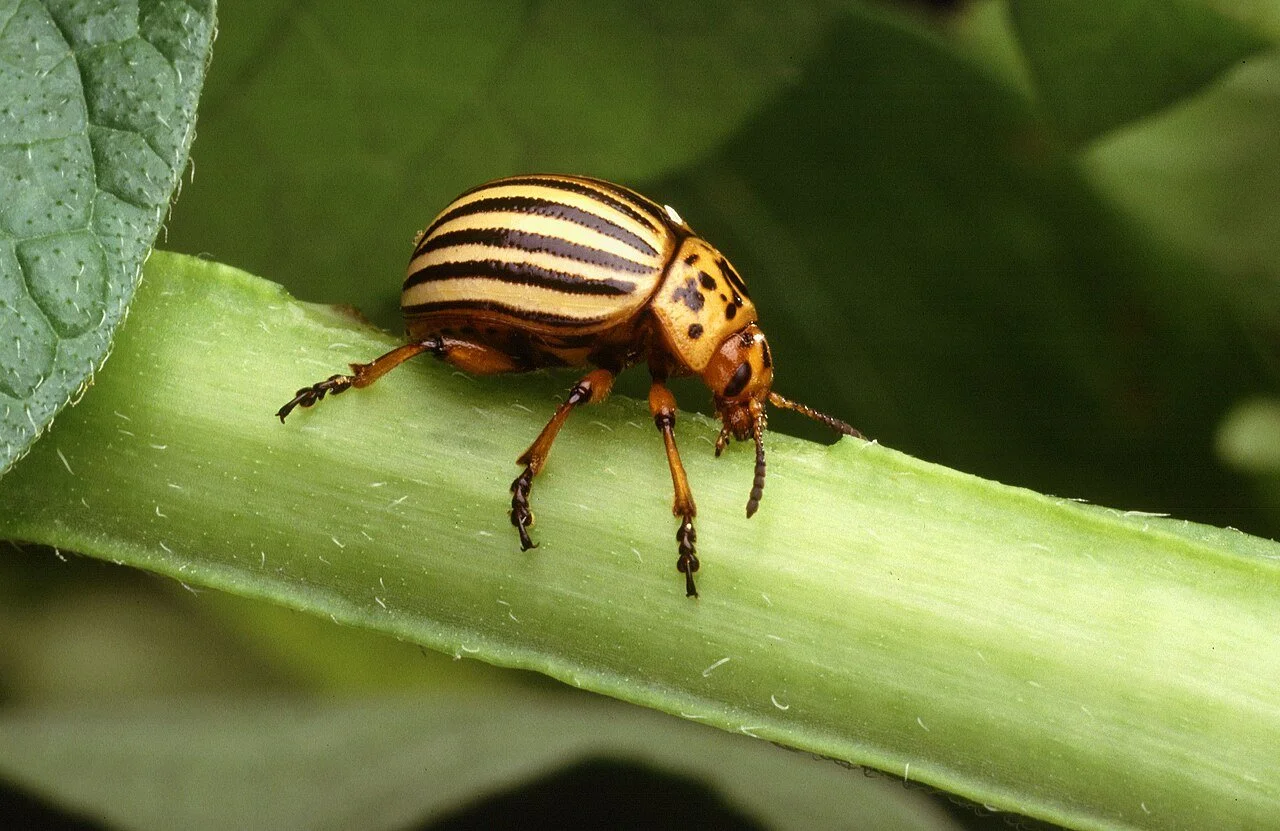
Colorado Potato Beetle
Pest prevention steps are:
Use certified seed potatoes.
Start with fresh clean soil mix.
Do not reuse potato/tomato soil from a diseased crop.
Keep foliage dry when possible.
Remove badly diseased leaves.
Do not compost diseased potato vines.
Growing Garlic, Onions & Alliums
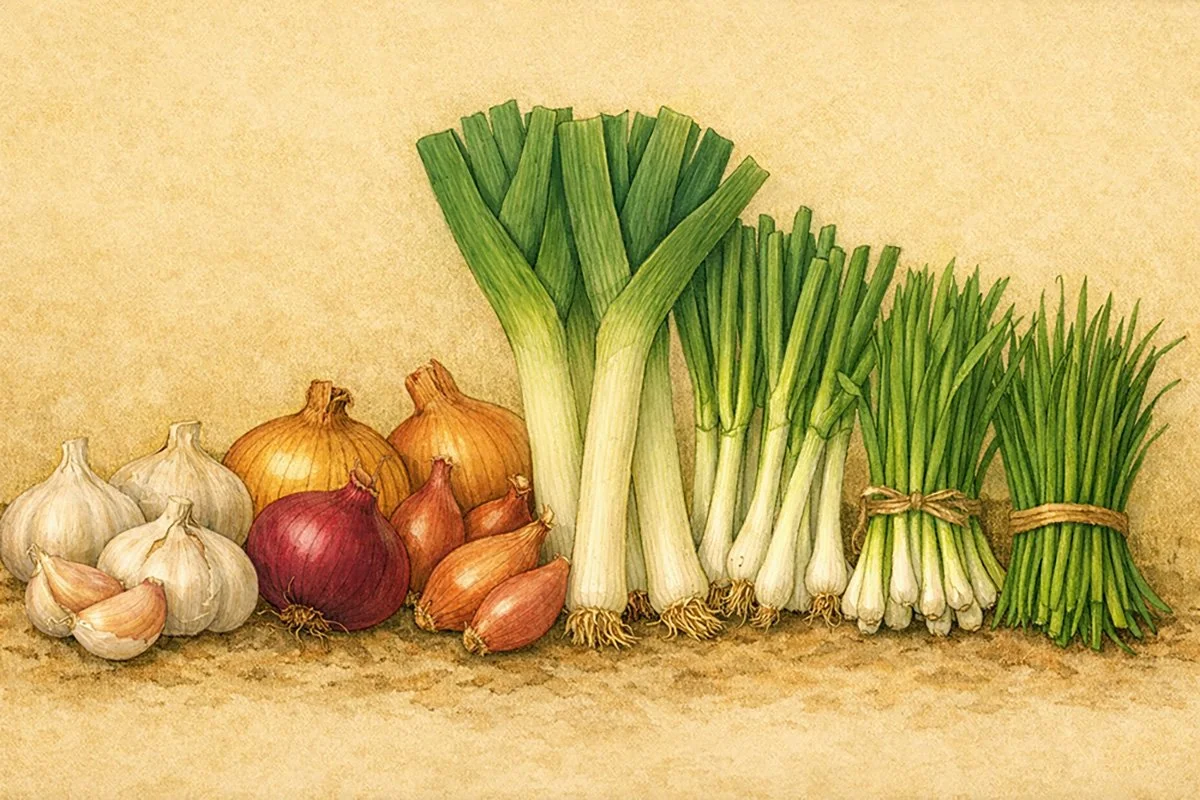
Garlic and onions are often casually grouped with root vegetables — but that is botanically incorrect. Garlic, onions, shallots, leeks, scallions, and chives all belong to the allium family: plants that grow as bulbs, which are modified stems surrounded by fleshy leaf bases.
When grown in loose, soil with modest fertility, alliums reward gardeners with large bulbs, excellent flavor, and long storage life. The best soil is a blend of low nutrient organic potting soil and our high nutrient compost. Gardeners buy the potting soil at a local vendor and we give them some PhoSul fertilizer to join our testing team.
What Are Alliums?
Garlic and onions are often casually grouped with root vegetables — but that is botanically incorrect. Garlic, onions, shallots, leeks, scallions, and chives all belong to the allium family: plants that grow as bulbs, which are modified stems surrounded by fleshy leaf bases. The underground bulb we harvest is not a root at all, but a tightly layered structure formed from swollen leaf bases attached to a small root plate.
This distinction matters for how we grow them. Root crops expand underground storage roots, while alliums build layered bulbs in response to seasonal signals — a combination of cold exposure, soil conditions, and day length. Because allium roots stay shallow, they cannot forage for nutrients deeper down and depend entirely on whatever is in the top layer of soil. Good soil structure and a healthy microbial environment are therefore essential.
When grown in loose, somewhat fertile soil rich in organic matter, alliums reward gardeners with large bulbs, excellent flavor, and long storage life. In many ways, alliums are indicators of how well the underground ecosystem is functioning. Garlic and alliums thrive with less nutrients (especially nitrogen) than fruiting and leafy veggies above ground.
Garlic Planting & Care Calendar
Fall Planting: Garlic is one of the simplest and most rewarding crops to plant in fall. The goal is to give each clove time to root before the ground freezes, without encouraging much top growth before winter. Plant garlic about 3–4 weeks before the ground freezes, ideally after the first hard frost. In Zone 6a, this typically means mid-October to early November. The cold exposure triggers proper bulb formation. Plant cloves pointed-end up, about 2 inches deep and space them about 6 inches apart.
Hardneck garlic: For colder climates like Zones 5b–6a, hardneck garlic is usually the best choice. It handles winter well and produces the bold flavor many gardeners are looking for.
Soil blend: With garlic, more nutrients is not always better. A strong start, a light touch, and healthy soil do most of the work. Don’t add compost or worm castings into garlic planting holes as we do for leafy and fruiting veggies. Too much compost (above 40%) retains excess moisture and raises the risk of bulb rot. Very high nutrients keep garlic bulbs small. Soil pH between 6.0 and 7.0 is best Mix 30% Deep Root high-nutrient compost with 70% low-nutrient organic potting soil. We don’t sell root veggie soil in the Deep Roots online store.
PhoSul fertilizer: We will give you a free small pouch of PhoSul fertilizer that works well with root veggies and alliums. The free PhoSul makes you part of our root veggie and allium testing team. Please report your harvest in weight and in photos. Add a small amount of PhoSul fertilizer – at most an 1/8 teaspoon – in the planting holes. Phosphorus supports early root development, and sulfur is especially valuable for alliums, helping build the flavor and natural protective compounds that make garlic such a standout crop. PhoSul is gentle, so even slightly more won’t matter.
Straw mulch: After planting, cover the bed with 2 to 4 inches of straw mulch to help regulate soil temperature, reduce frost heaving, and suppress early weeds.
Spring “top-dress” fertilizing: In spring, when garlic shoots reach about 4 to 6 inches tall, spread across the entire garlic bed surface a half inch layer of our high nutrient compost and worm castings. Garlic’s feeder roots spread outward not down, so a gentle bed-wide top-dress works better than fertilizing only at the stem.
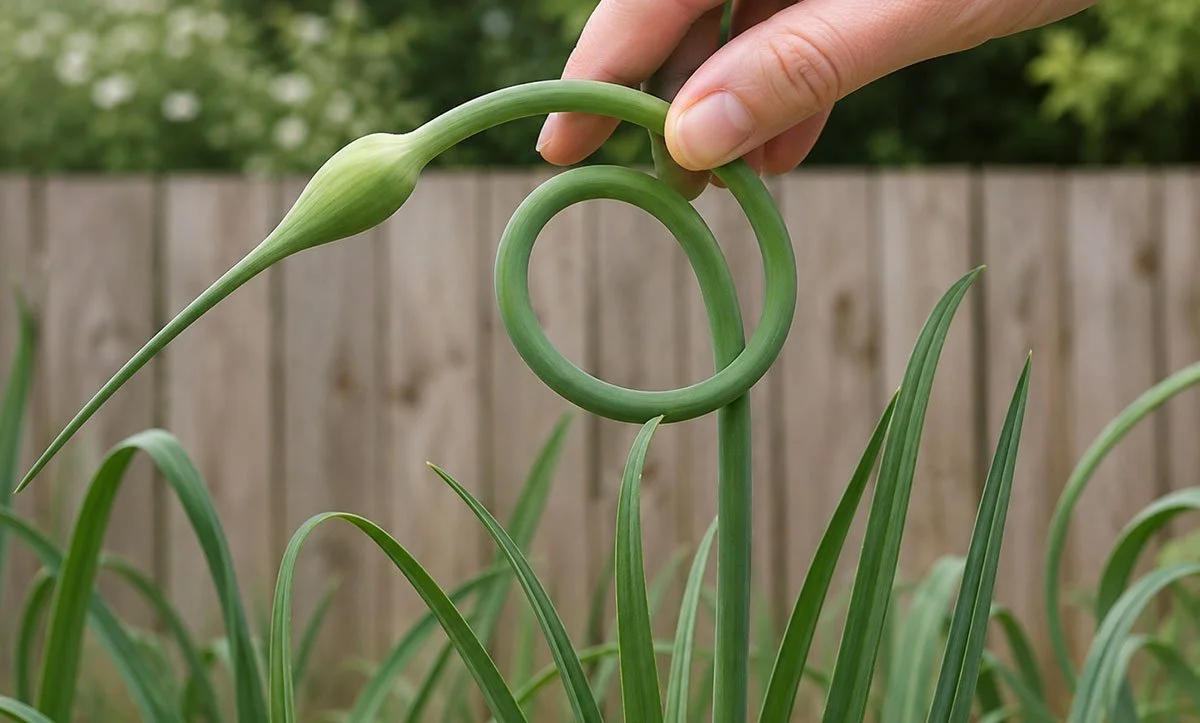
June Garlic Scape Removal: Hardneck garlic sends up a curling flower stalk called a “scape” in early summer. Wait until the scape begins twisting and forms about one full curl, then snap or cut it off. At this stage, the scape is tender, flavorful, and mature enough to harvest. If left longer, it may eventually flower, which diverts energy away from the bulb. To remove the scape, use clean scissors or garden shears and cut the stalk as low as you can without damaging the surrounding leaves. The leaves are still feeding the bulb, so avoid crushing or cutting them. Removing the scape helps the plant send more energy into bulb growth and can noticeably increase bulb size. Scapes are also a delicious early garlic harvest, with a mild, sweet garlic flavor and tender-crisp texture. Use them sautéed, grilled, in stir-fries, or blended into pesto..
Spring and early summer watering: During spring and early summer, garlic benefits from consistent moisture while the bulbs are expanding. As harvest approaches, stop watering completely about two weeks before you plan to harvest. This allows the bulb’s outer wrapper layers to dry and paper over properly — essential for quality and long storage.
July Garlic Harvest: Harvest when one-third to one-half of the lower leaves have turned brown while the upper leaves are still green. Do not wait for full browning — by then the protective wrapper has often begun to deteriorate and cloves may be separating. Loosen bulbs gently with a garden fork rather than pulling by the stem. Brush off loose soil but do not wash.
After Harvest Curing Garlic: Hang bulbs or lay them in a single layer in a shaded, well-ventilated spot for 3–4 weeks. Proper curing converts fresh-dug garlic into shelf-stable bulbs that store for months. Once fully cured, trim the roots and stems and store in a cool, dry location with good air circulation — never in sealed plastic.
Onions and Other Alliums
Garlic shares its family with onions, shallots, leeks, scallions, and chives. All share key characteristics: they grow from bulbs or bulb-like bases, have shallow root systems, and prefer loose, fertile soils rich in organic matter. Like garlic, they rely on temperature and day length to trigger bulb development. Well-prepared Deep Roots beds with 30% balanced high-nutrient compost and 70% low-nutrient root soil content serve all alliums well.
Like garlic, many edible and ornamental alliums are best planted in the fall (September through November) to allow roots to establish before winter, ensuring they bloom or harvest the following spring/summer. Key fall-planted alliums include shallots, leeks, perennial onions, and chives, .
Edible Alliums (Fall Planting):
Shallots: Planted in late September or October for early harvests.
Leeks: Hardy varieties can be planted to establish roots for spring growth.
Chives: Fall planting allows this perennial herb to return early, providing fresh leaves and purple flowers.
Perennial Onions (Potato/Multiplier Onions): Planted in September or October.
Fall Planting: The ideal time is after the first frost, but before the ground completely freezes. This usually falls between September and November depending on your hardiness zone. Plant in full sun (at least 6 hours) in well-drained soil to avoid bulb rot.
Companion Planting Garlic & Spinach
Garlic and spinach make excellent companions in fall-planted beds. Garlic’s scent deters pests like aphids that bother leafy greens, providing natural protection for the spinach in spring.
Plant garlic cloves and spinach seeds in the same bed in mid-October to early November.
Spinach sown in fall will overwinter under mulch or germinate early in spring, maturing well before garlic needs the full bed.
Inter-plant spinach between rows of garlic. Spinach can be harvested by May or early June — long before the July garlic harvest.
Use hardneck garlic varieties, which are better suited to Zone 5b and 6a winters.
Growing Root Vegetables - A New Method
Use a dedicated bed and a different soil to grow root vegetables - Deep Roots explains why.
If you’ve been growing tomatoes, greens, and herbs in 100% Deep Roots microbe-rich compost and loving the results — this post is not asking you to change a thing. Your compost method is exactly right for those above ground crops. This post is about one important exception – root vegetables which need low nutrient loose organic potting soil. We are giving a new roo veggie fertilizer to our gardeners who agree to test this new method by following our growing instructions and reporting their harvest with veggie weight and photos.
Why root crops need low nutrient soil
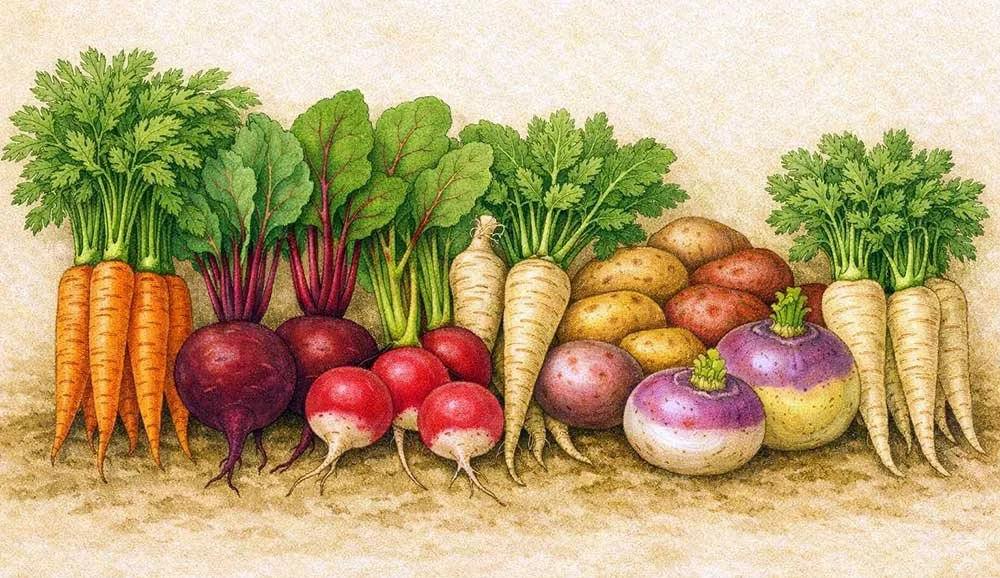
Root veggie rules: Carrots, beets, radishes, parsnips, turnips, sweet potatoes, potatoes and rutabagas play by different rules than everything else in your garden. The very richness that makes Deep Roots 100% compost great soil for tomatoes and above ground veggies works against root crops. High nutrients grow tiny roots. The good news: the fix is simple, and Deep Roots has made it even simpler by doing most of the prep work for you. Our blog posts on growing carrits, sweet potatoes and potatoes is comig soon. Learn more in our blog post on Growing Garlic, Onions and Alliums.
Roots store energy. Root crops aren’t trying to grow fast — they’re trying to store energy underground. Carrots, beets, radishes and parsnips only do that when they receive a specific signal that says “nutrients are present, but limited.” When nitrogen is too high — as it often is in manure-based compost — that signal never comes. Instead, the plant keeps putting all its plentiful energy into leaves. This is why gardeners sometimes see beautiful, bushy tops and disappointingly small roots. The plant is doing exactly what the soil chemistry is telling it to do.
Loamy & well-drained soil. The ideal soil is low-nutrient, loose organic sandy loam or potting soil. The pure compost Deep Roots uses as soil for above ground veggies lacks the mineral structure that root crops evolved in and holds too much water, dries unevenly, and encourages shallow or forked rooting. Also, don’t mix sand with sticky clumpy clay soil. The tiny particles of sand and clay bind together and change the soft clumps into very hard clumps.
PhoSul root crop fertilizer. When you test our free root fertilizser you become a member of our new root veggie method testing team. Just keep track of how many crops planted and the amound of the harvest . Take photos and weigh the harvested veggies. More details on PhoSul is below.
The solution: one dedicated root veggie bed
Root vegetables evolved in mineral soils with only modest organic matter. You don’t need to change your existing beds at all. Simply set up one dedicated root vegetable bed or large container with a low-nutrient soil. We are now testing difference blends of potting soil and sandy loam that will give roots exactly the growing environment they need. Reserve a separate container or area in your root veggie bed for the sifted soil carrots need.
Low nitrogen — Nitrogen is the plant nutrient that encourages leafy green growth. Root vegetables need some nitrogen, but too much can cause big tops and small roots. This soil is kept low in nitrogen so carrots, beets, parsnips, turnips and other root crops are encouraged to put more energy into the part you harvest: the root.
Mineral structure — “Mineral structure” means the soil contains the small mineral particles that give soil body and shape. Root vegetables need soil that is firm enough to support them, but loose enough for roots to push through. This helps carrots, beets, parsnips and turnips grow deeper, straighter and more evenly.
Low soluble salts — “Soluble salts” are minerals and nutrients dissolved in soil water. A little is normal, but too much can make it harder for young roots to take up water. This soil is designed to be low in soluble salts so roots can drink water more easily and expand without stress.
Good drainage — “Drainage” means how well extra water moves out of the soil. Root vegetables like steady moisture, but they do not like sitting in soggy soil. Good drainage helps prevent rotting, shallow growth and forked or twisted roots.
PhoSul: your new root veggie fertilizer
PhoSul is an OMRI-certified organic fertilizer made from rock phosphate and elemental sulfur. It contains no nitrogen. Phosphorus is the nutrient most responsible for root development in carrots, beets, parsnips, and turnips. PhoSul also releases calcium and silica as it breaks down, which gradually improves soil structure season after season. PhoSul fertilizerpurposefully incorporates sulfur to assist with nutrient release.
Build-and-maintain amendment: The best part is that PhoSul doesn’t leach out or the soil with water. Unlike nitrogen, which washes below the root zone every time you water, phosphorus bonds to soil particles and stays put. This means it builds a slow-releasing reserve your root crops can draw on all season long — without constant reapplication. Think of PhoSul as a build-and-maintain amendment, not a seasonal fertilizer you must continually renew. Instead, top it up lightly once a year, and over two to three seasons the bed will develop a stable phosphorus bank that works quietly beneath your root crops all season long.
To apply PhoSul: Put a pinch (1/8 teaspoon) of PhoSul in your planting hole for seedlings and seeds. It is very gentle and a little extra will not matter. When you buy our root soil, we will give you a small ziplock bag of PhoSul to add in at planting.
Carrots need loose soil without obstructions
Carrots need soil that is deep, loose and obstruction free to allow them to grow straight, large, and dense roots. To prevent forked and misshapen carrots, sift out wood chips, sticks, pebbles and other obstructions. Reserve a separate container or area in your root veggie bed for the sifted soil carrots need. Contact Deep Roots customer support to borrow our easy-to-use soil sifting tool that our carpenter created. Learn more in our blog post “Growing Carrots” (coming soon).
Garlic and Onions are NOT root crops
Garlic, onions, chives, leeks, shallots are alliums. It’s ideal soil and fertilizer has similarities to BOTH root veggies and above ground (fruiting and leafy) veggies. Garlic and other alliums require some nutrient rich compost in their soil, generous organic matter, and good nitrogen levels in early spring to grow large bulbs. The Deep Roots compost-rich beds your tomatoes thrive in are too nutrient-rich for garlic and cause tiny under-developed bulbs. Learn the details in our blog post Planting Garlic, Onions and Alliums.
Alliums need a soil blend: The solution is growing garlic and other alliums in their own bed or container using a soil blend of 30% Deep Roots high nutrient compost and 70% low nutrient potting soil. We like “Back to the Roots Organic All Purpose Potting MixPremium Blend”. Plant garlic cloves 22 inches deep in fall (late-October to mid November), apply a pinch of PhoSul fertilizer next to the clove and mulch with 2–4 inches of straw. In spring when seedlings reach 4–6 inches tall, top-dress (spread on all soil growing alliums) about a half inch of our compost. Harvest garlic when one-third to half of the leaves have browned.
Soil Blends for Potatoes and Sweet Potatoes
Like Alliums potatoes and sweet potatoes prefer well-drained low-nutrient loose topsoil, and DO NOT require large quantities of organic matter. Again “Back to the Roots Organic All Purpose Potting Mix” is a reliable choice. Over-fertilization tends to produce foliage instead of roots. A leaner nutrient soil is best.
Regular Potato Soil Blend: Mix 50% high-quality low-nutrient potting soil, 30% Deep Roots high-nutrient compost, 20% Deep Roots dense leaf mulch and potassium fertilizer like “Kelp Meal” or “Sulfate of Potash” Blend thoroughly, then fill beds or containers with loose, well-drained soil. This gives regular potatoes enough fertility without making the mix overly heavy. Learn the details in our blog post “Growing Potatoes” (coming soon).
Sweet Potato Soil Blend: Mix 5 parts low nutrient potting soil with 1 part nutrient-rich compost. Keep the blend light and only moderately fertile, since sweet potatoes produce better roots in leaner soil and too much nutrient richness can lead to excess vine growth. Learn the details in our blog post “Growing Sweet Potatoes” (coming soon).
Starting and Transplanting Root Vegetable Seedlings
Root vegetables that can be started indoors and transplanted include leeks, onions, and specifically "Clancy" variety potatoes, as they are less sensitive to root disturbance than others. Beets can sometimes be started indoors if transplanted very early, but most root crops like carrots, radishes, and parsnips are best direct-sown outside.
Root Vegetables for Indoor Starting
Leeks: Start 8-10 weeks before the last frost, as they handle transplanting well.
Onions: Can be started indoors 8-10 weeks early, with tops trimmed to 3 inches for stronger, transplant-ready plants.
Potatoes ('Clancy' variety): These can be started from seed indoors.
Beets: Generally better direct-sown, but can be started indoors and carefully separated if moved while small.
Why Most Root Crops Dislike Transplanting
Root vegetables develop a single taproot that is very sensitive to disturbance. Transplanting them often causes stunted, misshapen, or split roots. Tips for Success: Use biodegradable pots (like peat pots) to minimize root disturbance during the move to the garden. Ensure all plants are properly hardened off before moving them outside. For root crops that must be direct-sown (carrots, radishes, turnips), it is best to do so as soon as the soil can be worked.
What to expect
Learning to grow root crops is not a complicated change. Use dedicated beds or containers, filled with organic potting soil or a blend of potting soil and our compost. Everything else about your gardening stays the same. Your compost beds keep doing what they do best for tomatoes and greens. Your root veggie bed gets the low nutirent environment that finally lets carrots be carrots and beets be beets.
Plant something. Feed something. Protect something.
Deep Roots Project is here for every step of the journey.
“Grow Your Own Food” blog posts
See the full list of our Grow Your Own Food blog posts. Each post is assigned ”tags” which are under the post title. If you need a quick answer to a gardening question give us a call or send a text to our customer support team – support[at]deep-roots-project.org AND 708-655-5299.
Deep Roots online store
See our online store for details about prices, ordering and delivery of raised beds, planter boxes, microbe-rich compost, worm castings, leaf mulch and more. We don’t sell traditional soil, since we use 100% compost as our growing medium. Our online store has 2 sections – (1) raised beds and planter boxes and (2) compost, worm castings, fertilizer.
Please contact our customer support team before placing an order online so we can assist you with the details and answer your gardening questions. You can pay by credit card in the store or by check.
(708) 655-5299 and support[at]deep-roots-project.org
Sign up for our newsletter
Please leave your cell phone number when you sign up for our eNewsletter, if you want text message announcements now and then.
Donations help us provide organic kitchen gardening education to individuals, organizations, and entire communities. Thank you in advance for contributing to our community and for sharing our website and blog with friends and family.

Storing and Using Spinach and Lettuce
Here are 8 delicious vegan recipes for soups, stews, and dips that make excellent use of an abundant lettuce and spinach harvest, and also freeze well.
Freeze Lettuce & Spinach in Soups, Stews & Dips
Here are 8 delicious vegan recipes for soups, stews, and dips that make excellent use of an abundant lettuce and spinach harvest, and also freeze well.

Healthy Soups & Stews
Spinach and Lettuce Green Soup
• Ingredients: spinach, lettuce, onions, garlic, potatoes, vegetable broth, coconut milk, salt, pepper.
• Preparation: Sauté onion and garlic, add diced potatoes, spinach, lettuce, and broth. Simmer until tender. Blend until creamy, then stir in coconut milk.
• Freezing: Freeze in airtight containers; reheat gently.
Spinach, Lettuce, and White Bean Stew
• Ingredients: spinach, lettuce, cannelloni beans, tomatoes, onion, garlic, vegetable broth, Italian herbs, olive oil.
• Preparation: Sauté onion and garlic, add spinach, lettuce, tomatoes, beans, and broth. Season with Italian herbs, simmer until thickened.
• Freezing: Freeze portions in containers; thaw overnight before reheating.
Curried Lettuce and Spinach Soup
• Ingredients: spinach, lettuce, coconut milk, vegetable broth, onions, garlic, ginger, curry powder, turmeric, chili flakes, lime juice.
• Preparation: Sauté aromatics, add spinach, lettuce, broth, spices. Cook briefly, blend until smooth, finish with coconut milk and lime juice.
• Freezing: Freeze in serving-sized portions; thaw in refrigerator overnight.
Lentil and Spinach Stew
• Ingredients: spinach, lentils, lettuce, tomatoes, onion, carrots, celery, garlic, vegetable broth, cumin, smoked paprika.
• Preparation: Sauté vegetables, add lentils, spinach, lettuce, broth, and spices. Cook until lentils are tender and stew thickens.
• Freezing: Cool completely and freeze in airtight containers.
Delicious Dips
Spinach-Lettuce Pesto Dip
• Ingredients: spinach, lettuce, basil, garlic, nutritional yeast, walnuts, olive oil, lemon juice, salt, pepper.
• Preparation: Blend all ingredients until smooth. Adjust seasoning as needed.
• Freezing: Freeze in ice cube trays for easy portioning. Thaw cubes in the fridge overnight.
Creamy Spinach & Lettuce Hummus
• Ingredients: chickpeas, spinach, lettuce, garlic, tahini, lemon juice, cumin, salt, pepper, olive oil.
• Preparation: Blend all ingredients until creamy, adjust seasoning.
• Freezing: Portion into containers or bags; thaw overnight in fridge.
Spinach and Lettuce Artichoke Dip
• Ingredients: spinach, lettuce, artichokes, vegan cream cheese, nutritional yeast, garlic, onions, vegan mozzarella, salt, pepper.
• Preparation: Blend spinach, lettuce, garlic, cream cheese; fold in chopped artichokes and onions. Top with vegan mozzarella, bake until bubbly.
• Freezing: Freeze before baking; thaw and bake as needed.
Spicy Spinach and Lettuce Avocado Dip
• Ingredients: spinach, lettuce, avocados, jalapeño, garlic, lime juice, cilantro, cumin, salt.
• Preparation: Blend spinach, lettuce, garlic, jalapeño, cilantro. Mash with avocado, add lime juice, cumin, salt to taste.
• Freezing: Freeze in small airtight containers; defrost overnight in refrigerator and stir well before serving.
Join the Deep Roots movement
We’re not just about gardening; we’re about changing the way people grow food. Whether you have a tiny balcony or a full backyard, we’ll help you grow like a pro.
Stay in the loop: Signup for our email newsletter. If you also provide your phone number you will get text message updates that link to our best blog posts.
Get involved: Attend a free workshop, become a volunteer, grab a raised bed, or simply follow along for expert tips. Contact our support team any time you have a question at 708-655-5299 and support@deep-roots-project.org.
Learn. Share. Grow. Volunteer: We invite you to be a part of our sustainable movement right here in our own backyards! We want all our volunteers to have fun and learn while they contribute to expanding the Deep Roots community. We can customize a volunteer assignment to your time, interests and skills. Learn more on our Volunteer page
Dive Deeper
Click on the Blog Posts below for more about our Innovative methods.
Beautify Your Garden with Our Cedar Raised Beds!
Our Deep Roots handcrafted cedar raised beds are designed to endure outdoors while adding a touch of style to your yard. As a bonus, they are the perfect depth to hold just the right amount of our nutrient-rich compost growing medium, which comes free with each bed.
Deep Roots Supports Gardeners
We provide our gardeners with the best products for success – like cedar raised beds, microbe-rich compost and microbe-rich worm castings.
Call our customer support team with any questions or help with calculations. Then place your order online. If you need help or have a question contact us at support[at]deep-roots-project.org and 708-655-5299.
See our online store for details about prices, ordering and delivery of raised beds, planter boxes, microbe-rich compost, worm castings, leaf mulch and more. We don’t sell traditional soil, since we use 100% compost as our growing medium. Our online store has 2 sections
Signup for Our Newsletter
Please leave your cell phone number when you sign up for our eNewsletter to get gardening and seasonal text messages announcements now and then.
Donations help us provide organic kitchen gardening education to individuals, organizations, and entire communities. Thank you in advance for contributing to our community and for sharing our website and blog with friends and family.

Red Malabar Spinach: A Heat-Loving, Edible Beauty
If you’re looking for a leafy green that thrives when the summer sun is blazing and most other greens have called it quits, Red Malabar Spinach is your new garden best friend. Free seeds are available from us in May and June 2025. Contact the Deep Roots support team at 708-655-6299 or support[at]deep-roots-project.org.
A Heat-Loving, Edible Beauty
If you’re looking for a leafy green that thrives when the summer sun is blazing and most other greens have called it quits, Red Malabar Spinach is your new garden best friend.

Not a True Spinach
With its deep red stems, lush vining habit, and glossy, succulent leaves, this plant is as beautiful as it is useful. Although it’s not technically a true spinach, the taste and texture are close enough that many gardeners use it the same way and fall in love with it for its resilience and beauty.
Red Malabar Spinach, also called New Zealand spinach, climbing spinach, or Ceylon spinach, is officially known as Basella rubra. Native to India and tropical Asia, this plant thrives in heat and humidity. The hotter the summer, the more it seems to flourish.
Eat Raw or Cooked
The leaves are crisp and citrusy when eaten raw and mellow and earthy when cooked. You can toss it into salads, stir it into soups and curries, or blend it into green smoothies. It even produces vivid purple berries that aren't particularly flavorful, but they’re so striking that they’re sometimes used as a natural dye.
In India, the leaves are often sautéed with garlic, onion, chili, and mustard oil—a delicious combination worth trying. Cooked, the leaves are silky but not slimy. Raw, they’re juicy and full of bright, fresh flavor.
Growing Tips
At Deep Roots Project, we grow Malabar spinach using our signature method—100% living compost instead of traditional soil, enriched with worm castings for maximum microbial and nutrient density. This creates the ideal environment for Malabar spinach to grow large, strong, and flavorful, with none of the synthetic inputs used in conventional gardening. Our raised beds packed with life are perfect for heat-loving climbers like this one.
This vigorous vine needs a warm environment, a sturdy large trellis, and consistent moisture to perform at its best. It prefers full sun, though it can tolerate some shade, and it grows rapidly once the weather warms. A couple of plants are usually plenty for a household, producing baskets of leafy greens all through the hot months of summer and into early fall.
Plant Seeds or Stem Cuttings
You can grow Red Malabar Spinach from either seeds or stem cuttings in raised beds or containers. Seeds benefit from scarification—lightly scratching the surface with a nail file or sandpaper helps speed up germination.
Start the seeds indoors six weeks before the last frost if you live in a cooler region like Zone 5b or 6a. Transplant seedlings into the garden only once the soil has fully warmed and there’s no longer any threat of frost. In warmer zones, you can direct sow the seeds in late spring.
Stem cuttings root easily, and pruned vines can often be re-planted directly into the soil to continue growing. That’s just one more reason gardeners love this plant—it’s generous and forgiving.
When planting, give each vine plenty of space to spread out and something to climb. A fence, an arbor, or even an old tomato cage can do the trick. Some gardeners train it to grow over entryways or pergolas, letting the edible vines double as ornamental greenery.
Don’t plant next to large plants like tomatoes and cucumbers since it will grow all over the neighboring plants.
Keep Well Watered
The plant does best in rich, moist soil, and like many leafy greens, it can become bitter if it’s allowed to dry out or go to seed. So keep it well watered and pick the young leaves often to encourage fresh growth and discourage flowering.
Harvesting Tips
Harvest begins once the vines are established. Just snip off the growing tips and tender leaves as needed, leaving the stems to keep producing. The more you harvest, the bushier and more productive your plant becomes.
This plant is a gift for anyone who loves greens but struggles to keep them alive in the peak of summer. Where lettuce and spinach wither, Malabar spinach comes into its own, providing a steady harvest of greens during the hottest weeks of the year. It’s also a great choice for small-space gardens, since it can be grown vertically, freeing up room for other crops.
Save Your Seeds
If you want to save seeds for the next season, let a few berries mature on the vine until they turn deep purple. Once they dry, store them in a cool, dry, dark place. Avoid exposing them to high heat, which can damage their ability to germinate. A paper envelope or sealed glass jar in a cupboard works well.
Perfect for Hot Summers
Malabar spinach is one of those plants that seems too good to be true—gorgeous, delicious, productive, and practically bulletproof in the heat. Whether you’re a seasoned gardener or trying your hand at summer greens for the first time, this one’s worth a spot in your raised bed or container garden.
Free Seed Offer for Spring 2025
To help introduce Red Malabar to our local community, Deep Roots is offering free seeds during May and June 2025. Please contact our customer service team at 708-655-5299 or support@deep-roots-project.org.
Join the Deep Roots movement
We’re not just about gardening; we’re about changing the way people grow food. Whether you have a tiny balcony or a full backyard, we’ll help you grow like a pro.
Stay in the loop: Signup for our email newsletter. If you also provide your phone number you will get text message updates that link to our best blog posts.
Get involved: Attend a free workshop, become a volunteer, grab a raised bed, or simply follow along for expert tips. Contact our support team any time you have a question at 708-655-5299 and support@deep-roots-project.org.
Learn. Share. Grow. Volunteer: We invite you to be a part of our sustainable movement right here in our own backyards! We want all our volunteers to have fun and learn while they contribute to expanding the Deep Roots community. We can customize a volunteer assignment to your time, interests and skills. Learn more on our Volunteer page
Dive Deeper
Click on the Blog Posts Below for more about our Innovative methods.
Beautify Your Garden with Our Cedar Raised Beds!
Our Deep Roots handcrafted cedar raised beds are designed to endure outdoors while adding a touch of style to your yard. As a bonus, they are the perfect depth to hold just the right amount of our nutrient-rich compost growing medium, which comes free with each bed.
Deep Roots Supports Gardeners
We provide our gardeners with the best products for success – like cedar raised beds, microbe-rich compost and microbe-rich worm castings. Check our online store. Always talk to our customer support team before placing your order online. If you need help or have a question contact us at support[at]deep-roots-project.org and 708-655-5299.
Deep Roots Online Store
See our online store for details about prices, ordering and delivery of raised beds, planter boxes, microbe-rich compost, worm castings, leaf mulch and more. We don’t sell traditional soil, since we use 100% compost as our growing medium. Our online store has 2 sections – (1) raised beds and planter boxes and (2) compost, worm castings, fertilizer.
Please contact our customer support team before placing an order online so we can assist you with the details and answer your gardening questions. You can pay by credit card in the store or by check.
Please leave your cell phone number when you sign up for our eNewsletter, if you want text message announcements now and then.
Donations help us provide organic kitchen gardening education to individuals, organizations, and entire communities. Thank you in advance for contributing to our community and for sharing our website and blog with friends and family.

Tomato Growing Myths & Mistakes
Tomatoes are the crown jewel of backyard gardens. No vegetable gets planted with more anticipation or more heartbreak when things go wrong. If you’ve struggled to get a good tomato harvest—or you’re growing them for the first time—this guide is here to help you avoid five common mistakes and grow juicy, healthy tomatoes the Deep Roots way.
Tomatoes are the crown jewel of backyard gardens. No vegetable gets planted with more anticipation or more heartbreak when things go wrong. If you’ve struggled to get a good tomato harvest—or you’re growing them for the first time—this guide is here to help you avoid five common mistakes and grow juicy, healthy tomatoes the Deep Roots way.

Mistake #1: Leaving the Lower Leaves On
One of the biggest mistakes gardeners make is leaving the lowest leaves on the tomato plant after it's been transplanted. These early leaves once served a purpose—helping the seedling break through the soil and photosynthesize—but once the plant grows taller, they become liabilities.
Rain and irrigation can splash soil up onto these bottom leaves, spreading fungal and bacterial diseases. By trimming the leaves below the first flower cluster, you dramatically reduce the risk of infection. This also improves airflow at the base, helping your tomato plant stay dry and disease-free.
Pro tip: If you’re planting tomatoes deep to encourage rooting along the stem (a great idea), trim the lower branches a few days before transplanting. That gives the stem time to heal and prevents infection from open wounds.
Mistake #2: Fertilizing the Wrong Way or Not Enough
Tomatoes are heavy feeders. Unlike forest ecosystems, vegetable gardens don’t replenish their nutrients naturally—everything the plants take from the soil must be put back by you.
Many gardeners under-fertilize or use low-quality fertilizers. At Deep Roots Project, we recommend a powerful, soil-friendly combination: worm castings and fish emulsion.
Why Deep Roots fertilizers work better. Most powdered fertilizers—especially the ones sold in bags at big-box stores—are manufactured from isolated nutrients. These quick-fix formulas may “green up” your plants fast, but they don’t feed the soil, and over time, your soil becomes depleted.
Worm castings are nature’s perfect slow-release fertilizer. Made by red wiggler worms from nutrient-dense organic matter, they’re packed with microbes that wake up your soil and help roots absorb nutrients better. They improve soil structure, water retention, and disease resistance—benefits that powdered fertilizers just can’t match.
Fish emulsion, especially cold-processed organic types, gives your tomatoes a gentle, balanced dose of nitrogen, phosphorus, and potassium. It’s also loaded with micro-nutrients and beneficial bacteria. When watered in every two weeks, it keeps your tomatoes growing strong without the harsh chemical burn of synthetic options.
Our Suggested Routine (Every Two Weeks):
• Top-dress each plant with ½ to 1 cup of worm castings.
• Water in with fish emulsion (about 2–3 tablespoons per gallon).
• Repeat every 14 days for happy, productive plants.
Want to go 100% organic? Great. Need to cut costs and mix in a bit of a commercial product? Fine. But always keep high-quality compost and natural fertilizers at the heart of your routine. Healthy soil = healthy tomatoes.
Mistake #3: Over-Pruning Tomato Plants
Pruning has become a trend among tomato growers—but many are doing too much. For determinate (bush) or dwarf varieties, never prune above the first flower cluster. These plants are pre-programmed to stop growing at a certain height. Over-pruning means fewer fruits.
For indeterminate tomatoes (which keep growing all season), it’s tempting to remove every sucker (the shoots that grow between the main stem and branches). But unless you're growing inside a greenhouse with 20-foot vertical space, this "single-stem" method will lower your yield. In a home garden, allow suckers to develop—especially ones low on the plant that your support structure can handle. More suckers = more flowers = more tomatoes.
Key takeaway: Prune for airflow and structure, not out of habit. If you can’t explain why you're pruning a certain branch, don't prune it.
Mistake #4: Planting Too Late in Warm Climates
If you live in a hot, humid region, timing is everything. Once daytime temps consistently hit 90°F and nights don’t dip below 70°F, tomato flowers won’t pollinate. Pollen becomes sticky, and flowers drop without forming fruit.
In cooler regions, gardeners are taught to wait until the danger of frost is well past. But in the South and other hot climates, waiting too long can mean a total harvest failure. Tomatoes should be planted early in spring, so they reach their peak flowering before the worst summer heat arrives.
If you're relocating from a northern state, adjust your timing expectations. Aim to plant tomatoes on the shoulder season—early enough to flower before the summer swelter.
Mistake #5: Believing the 'Full Sun' Myth
“Full sun” is a misleading term. While tomato seedlings love spring sunshine, intense summer sun stresses the plants, making them more vulnerable to disease and insect attack.
In their native tropical forests, tomatoes grow as sprawling vines under a canopy of dappled light. That’s why Deep Roots recommends 40% shade cloth during the summer.
Here's the winning formula:
• Let your tomatoes soak up the full sun in spring (April–May).
• Then, install shade cloth starting around Memorial Day to mimic their native light conditions.
This keeps your plants cool, reduces disease pressure, and extends your harvest by 45 to 60 days.
Final Thoughts on Tomato Mistakes
Whether you’re growing five tomato plants or fifty, mastering these five tips will set you up for success. Use Deep Roots Project’s organic fertilizers, plant at the right time, prune wisely, and protect your tomatoes with shade when the summer sun turns brutal.
Tomatoes may be the most beloved crop in the garden—but they’re also one of the trickiest. With a little knowledge and the right soil-building approach, your tomato patch can become the envy of the neighborhood.
The Tomato Pruning Debate
Pruning tomato plants has been a topic of debate among gardeners. Some claim that it increases yield, while others believe it's unnecessary. Scientific evidence does suggest that pruning can have specific benefits, but the extent of its impact on yield can vary based on factors like tomato variety, growing conditions, soil nutrients/microbes and pruning techniques.
Recent research has begun to challenge the long-held belief that pruning tomato plants invariably leads to better yields and healthier crops. While pruning can offer certain benefits, such as improved air circulation and disease prevention, studies suggest that its impact on yield and fruit quality may not be as significant as once thought.
Are Benefits of Pruning Tomatoes Just a Myth?
Pruning is not a myth, but its benefits can be specific to certain circumstances:
Indeterminate vs. Determinate Varieties: Pruning is more beneficial for indeterminate varieties that continue to grow and produce fruit throughout the season.
Disease Management: Improved air circulation from pruning can reduce the risk of fungal diseases.
Fruit Quality: Pruning can result in larger, higher-quality fruits.
However, for determinate varieties, which produce fruit in a shorter, more concentrated period, pruning is less critical and may not increase yield.
A Recent Science on Tomato Pruning
Studies collected by The Spruce suggest that while pruning can have specific benefits, such as disease prevention and plant manageability, it may not universally enhance yield or fruit quality. Home gardeners should consider factors like tomato variety, local climate, and available resources when deciding on pruning practices. For instance, determinate varieties often require minimal pruning, while indeterminate types may benefit from selective pruning to manage growth. Read full article by The Spruce “Should You Prune Out Tomato Suckers.”
The Spruce is committed to the quality and trustworthiness of their content and editorial processes. Their team of writers, editors, fact checkers, illustrators, photographers, and medical and financial professionals rigorously researches and reviews all content on an ongoing basis to ensure it is up to date, accurate, and puts the needs of their readers first. Learn more at The Spruce Content Integrity Promise
Customize Your Pruning Methods
In summary, pruning should be tailored to individual gardening contexts rather than applied as a one-size-fits-all solution. Understanding the specific needs of your tomato plants and observing their responses to pruning can lead to more informed and effective gardening practices.
Join the Deep Roots movement
We’re not just about gardening; we’re about changing the way people grow food. Whether you have a tiny balcony or a full backyard, we’ll help you grow like a pro.
Stay in the loop: Signup for our email newsletter. If you also provide your phone number you will get text message updates that link to our best blog posts.
Get involved: Attend a free workshop, become a volunteer, grab a raised bed, or simply follow along for expert tips. Contact our support team any time you have a question at 708-655-5299 and support@deep-roots-project.org.
Learn. Share. Grow. Volunteer: We invite you to be a part of our sustainable movement right here in our own backyards! We want all our volunteers to have fun and learn while they contribute to expanding the Deep Roots community. We can customize a volunteer assignment to your time, interests and skills. Learn more on our Volunteer page
Dive Deeper
Click on the Blog Posts Below for more about our Innovative methods.
Beautify Your Garden with Our Cedar Raised Beds!
Our Deep Roots handcrafted cedar raised beds are designed to endure outdoors while adding a touch of style to your yard. As a bonus, they are the perfect depth to hold just the right amount of our nutrient-rich compost growing medium, which comes free with each bed.
Deep Roots Supports Gardeners
We provide our gardeners with the best products for success – like cedar raised beds, microbe-rich compost and microbe-rich worm castings. Check our online store. Always talk to our customer support team before placing your order online. If you need help or have a question contact us at support[at]deep-roots-project.org and 708-655-5299.
Deep Roots Online Store
See our online store for details about prices, ordering and delivery of raised beds, planter boxes, microbe-rich compost, worm castings, leaf mulch and more. We don’t sell traditional soil, since we use 100% compost as our growing medium. Our online store has 2 sections – (1) raised beds and planter boxes and (2) compost, worm castings, fertilizer.
Please contact our customer support team before placing an order online so we can assist you with the details and answer your gardening questions. You can pay by credit card in the store or by check.
Please leave your cell phone number when you sign up for our eNewsletter, if you want text message announcements now and then.
Donations help us provide organic kitchen gardening education to individuals, organizations, and entire communities. Thank you in advance for contributing to our community and for sharing our website and blog with friends and family.

Pruning Blackberry, Raspberry and Blueberry Bushes
Pruning is an essential gardening practice that keeps your blueberry and raspberry bushes productive, healthy, and easy to manage.
Pruning is an essential gardening practice that keeps your blackberry, blueberry and raspberry bushes productive, healthy, and easy to manage. While pruning can seem intimidating, it’s straightforward once you understand the seasonal needs of each plant. Here’s what you need to know about pruning your berry bushes in both spring and fall.
Pruning Raspberry Bushes
Spring Pruning (Late Winter to Early Spring)
Raspberry pruning depends on whether you’re growing summer-bearing or ever-bearing (fall-bearing) varieties.
As a rule, for both varieties, always remember to cut the canes out at the ground level and remove the cut canes completely from the bed. The cut canes often harbor diseases, so you do not want to use them as mulch around the existing plants.
For summer-bearing raspberries:
Summer-bearing raspberries require two prunings.
Immediately after harvest, remove all the canes that fruited (floricanes).
Thin remaining canes to about 6 inches apart, keeping the strongest ones for fruit production.
In spring, cut back the side shoots on the floricanes slightly - remove less than one-fourth of the length of the cane. This procedure is called “heading back” and prevents the shoots from becoming too heavy.
Trim any overly long or weak canes to about 4-5 feet tall to encourage sturdy growth.
For ever-bearing raspberries:
The most efficient method for fall bearing raspberries is to cut them all down every fall after harvest. Treating them like an annual crop this way gives you only one large crop in late summer or early fall. But it is a good way to avoid disease and damage from rabbits by overwintering canes.
If you want a summer and fall harvest, remove only the top portion of canes that fruited in the fall, leaving the lower part to bear fruit in early summer. After these canes fruit the following summer, cut them out at ground level.
Be sure to monitor carefully and immediately remove any canes that show signs of disease.
Black and Purple Raspberries
When the primocanes are 2 feet high in the summer, pinch out the tip of each shoot. This will cause side shoots to grow, increasing your harvest and making the berries easier to reach.
After harvest, cut out all the canes that fruited.
In early Spring, cut back side branches to 12 inches, and remove all but four to five of the best canes.
Final Tips for Success
Always use sharp, clean pruning shears to prevent damage and disease spread.
Label your berry varieties if you grow both summer-bearing and ever-bearing raspberries to ensure proper pruning.
Prune on a dry day to reduce the risk of fungal infections entering fresh cuts.
Prepare for winter. If you live in a cold climate, consider tying up raspberry canes to prevent wind damage and adding mulch at the base for insulation.
Pruning Blackberry Bushes
Note - Blackberries are not generally recommended in northern Illinois. They are not normally hardy enough for our climate. However, if you are in a more moderate micro-climate close to Lake Michigan and have a spot protected from strong winds - then you may be able to grow Blackberries successfully.
Training & Pruning Blackberries
Blackberries produce on second year canes. You train them the same way you do black raspberries: prune the tips of the canes the first season when they reach four feet in order to stiffen the canes.
Prune out canes that have fruited immediately after harvest or any time before Spring growth begins.
In early Spring while the plants are still dormant, cut back each side shoot to 8 inches.
Remove dead, damaged, or diseased canes. This prevents disease and promotes healthy growth.
Tip-prune the canes. Cut back the top few inches of young, vigorous canes to about 3-4 feet to encourage lateral branching and increase fruit yield.
Space out canes. Keep about 6 inches between canes to ensure good airflow and reduce disease risk.
Fall Pruning (After Harvest)
Remove spent floricanes. If not done earlier, cut back any canes that fruited during the summer to ground level.
Thin the primocanes. Leave only the healthiest, strongest new canes for next year’s fruiting, spacing them about 6 inches apart.
Cut back lateral branches. Trim lateral growth to about 12-18 inches to encourage better fruit production the following season.
Prepare for winter. In colder climates, consider tying canes to a trellis and applying mulch around the base for insulation.
Final Tips for Success
Always use sharp, clean pruning shears to prevent damage and disease spread.
Label your berry varieties if you grow different types to ensure proper pruning.
Prune on a dry day to reduce the risk of fungal infections entering fresh cuts.
Pruning Blueberry Bushes
Special reminder: Blueberries require acid soil of pH around 4.5. Our regular Deep Roots compost and worm castings have a pH of around 7. Create special soil blend and use a low pH fertilizer.
Skip the first 3 years
It is not necessary to prune new blueberry bushes for the first three years after planting.
Spring Pruning (Late Winter to Early Spring)
After three years, begin pruning every year while the plants are still dormant.
Late Winter or early Spring is the best time to assess winter damage and shape your blueberry bushes for a strong growing season.
Remove dead, damaged, or diseased branches. These branches won’t contribute to healthy growth and can spread disease.
Remove weak shoots and twigs less than 6 inches long to let in more light, reduce the risk of fungal infections, and produce more fruit.
Renewal Pruning. Blueberries produce fruits on second year growth. Every couple of years remove the oldest and heaviest branches. New shoots will grow from the base of the plant and produce a better crop.
• Limit excessive height. Trim back overly tall stems to keep the plant manageable and promote fruiting within easy reach. Ideally, prune back long canes to about 4-5 feet in height.
Fall Pruning Not Needed for Blueberries
In general you do not prune Blueberries in the fall.
Fall pruning will stimulate new growth too late in the season, which may not survive winter.
You may want to remove any diseased or broken branches. This helps prevent issues from carrying over into winter. But avoid major cuts. Save heavy pruning for early spring when the plant is dormant.
Clean up debris. Rake and remove fallen leaves and pruned material to reduce the risk of pests and disease overwintering in your garden.
Happy Gardening!
With regular pruning, your blueberry, raspberry, and blackberry bushes will reward you with abundant, high-quality fruit for years to come. See the full list of our Grow Your Own Food blog posts. Each post is assigned ”tags” which are under the post title.
Deep Roots Supports Gardeners
We provide our gardeners with the best products for success – like cedar raised beds, microbe-rich compost and microbe-rich worm castings. Check our online store. Always talk to our customer support team before placing your order online. If you need help or have a question contact us at support[at]deep-roots-project.org and 708-655-5299.
Deep Roots Online Store
See our online store for details about prices, ordering and delivery of raised beds, planter boxes, microbe-rich compost, worm castings, leaf mulch and more. We don’t sell traditional soil, since we use 100% compost as our growing medium. Our online store has 2 sections – (1) raised beds and planter boxes and (2) compost, worm castings, fertilizer.
Please contact our customer support team before placing an order online so we can assist you with the details and answer your gardening questions. You can pay by credit card in the store or by check.
Please leave your cell phone number when you sign up for our eNewsletter, if you want text message announcements now and then.
Donations help us provide organic kitchen gardening education to individuals, organizations, and entire communities. Thank you in advance for contributing to our community and for sharing our website and blog with friends and family.

Cabbage Family (Brassica) Tips
Broccoli, Brussel sprouts, cauliflower and cabbage
Many nutrition experts say that broccoli and kale are the most healthy of all veggies and worth their weight in gold. But, in our area Broccoli, Brussel Sprouts, Cauliflower and Cabbage are more heavily damaged by pests like the cabbage looper and cabbage worm than other plants in the Cabbage Family. Plus, broccoli can be heavily damaged by “clubroot,” making it the most difficult of the cabbage family veggies to grow in our area. These growing tips will give you the knowledge to grow all the cabbage family veggies successfully. But as you will see the extra time and energy may not be worth the return.
Broccoli and kale are super foods and worth their weight in gold. Cabbage/Brassica Family includes Arugala, Bok choi, Broccoli, Brussel Sprouts, Cabbage, Cauliflower, Collards, Cress, Horseradish, Kale, Kolhrabi, Mustard Greens, Radishes, Rutabagas, Turnips. In greater Chico area Broccoli, Brussel Sprouts, Cauliflower and Cabbage.

Planting and care tips
Our goal is healthy veggies. The goal is to keep the pests under control so your harvest is not severely damaged or your yield reduced. Cruciferous vegetables is another name for the Cabbage Family (Brassica) plants.
We don’t expect 100% perfect veggies. We can eat green leafy veggies with a few (caterpillar (cabbage worm) holes as long as we wash them first. A few holes doesn't hurt humans or the plant. But a few holes may not be okay with neighbors and friends who share your harvest.
Biodiversity planting helps control pests. Mixing together many friendly plants (companions) in the same bed masks the scent of the plant that the pest is attracted to. It also helps to grow pest resistant varieties of your favorite veggies. View our blogpost on biodiversity
The swede midge fly (Contarinia nasturtii), an invasive pest from Europe, has begun wreaking havoc on brassica crops. including radish, horseradish, rutabaga, turnip, rapeseed (canola), arugula, bok choy and Chinese cabbage. Crops that are most damaged include common favorites such as broccoli, cauliflower, cabbage, kale, kohlrabi, collards and Brussels sprouts. Since we have not yet found a pesticide for swede midge our sollution is to grow only collards and kale. We harvst as soon as large leves appear throughout the sesaon. If swede midge damage appears on the base of the leaf, we cut it off and wash all harvested leaves. View our blog post on Swede Midge.
Club Root disease: Many local home gardeners have given up growing broccoli and focus instead on other greens like kale, Swiss chard, Chinese cabbage, Chinese broccoli and Bok Choy. Protection from Club Roots takes time, knowlege and determination. It’s best to grow from seed to avoid buying contaminated seedlings. Watch this video on club root disease.
Companion plants that discourage cabbage worms are catnip, dill, geranium, nasturtium, sage, and thyme. Plants that discourage cabbage loopers are catnip, dill, nasturtium, peppermint, rosemary, sage, spearmint, and thyme.
Companion aromatic plants that repel and block pests are sage, rosemary, thyme, mint and nasturtium. The smell of these herbs and flowers in particular make multiple brassica pests turn the other way.
Get help from the experts on pests from your local botanic garden and state university agricultural extension.
In our experience kale is more resistant to pests than any of the other cabbage family varieties.
The three main brassica pests are flea beetles, aphids, and cabbage worms. Flea beetles are very tiny and hop around like fleas.
An easy first line of defense against pests are crop rotation, biodiversity planting and “floating row cover.” If you still get some caterpillars check our post on Environmental Pest Management.
Floating row cover on all brassicas for the whole season will prevent cabbage moths from laying their eggs on your plants. Floating row cover is a thin white gardening fabric that allows in sunlight and rain. Weight down the fabric edge so the moths can’t fly inside. This only works in a bed that has NOT grown cabbage family veggies last year since the eggs could be in the soil and will hatch into cabbage moths. See our blog post Installing Hoops on Raised Beds.
Bok choi (Pak choi) is a type of Chinese cabbage. The plant is a member of the brassicae or cruciferae families, also known as mustards, crucifers, or cabbages.
The easiest brassicas to grow are short-season greens like baby kale, mustard greens, or bok choy are the. Sown in early spring or late summer, they will start producing baby greens in just a few weeks and maybe harvested at full size for cooking.
The healthiest cruciferous vegetables may include Broccoli, Brussels sprouts, Cabbage, Cauliflower, Kale. Various studies have reported that eating more cruciferous vegetables has several health benefits.
For more tips on planting seeds and seedlings, managing pests and our local Planting Calendar go to our blog posts:
Broccoli growing tips
Broccoli is a sun-loving, cool-season crop that is best grown in the spring or fall. It’s also incredibly healthy, rich in vitamins and minerals, and is a good source of Vitamin A, potassium, folic acid, iron, and fiber.
Broccoli is attacked by multiple pests and diseases in our area. Our main problem is “Club Root.” Many local home gardeners have given up growing broccoli and focus instead on other greens like kale, Swiss chard, Chinese cabbage, Chinese broccoli and Bok Choy. The Deep Roots team is still researching this problem. We suggest growing broccoli in a container with fresh Deep Roots compost. Don’t use tools and gloves that have been used with other soil,
Planting: Broccoli thrives at 65°F to 70°F and is very sensitive to temperature. Plant in early spring when the soil is damp since broccoli will bolt in warm weather and not produce the “floret” (the bushy part). You want the plant to move slowly into seed and have time to give maximum energy to producing the large floret. Plant seedlings (with 4 or 5 leaves) about 2 to 3 weeks before the last spring frost date. Consult planting locations in our Biodiversity method post.
Care: Keep moist but don’t over water. Provide consistent soil moisture especially in drought conditions (1-1.5 inches of water per week.) Don’t get the heads wet when watering, as it can encourage rot. Roots are very shallow, so try not to disturb the plants. Mulch to suffocate weeds and to help keep soil temperatures down. To promote the growth of a second head after the first has been harvested, maintain watering schedule.
How to harvest broccoli: Harvest broccoli in the morning before it heats up when the buds of the head are firm and tight, just before the heads flower. If you do see yellow petals, harvest immediately, since flowering will decrease quality of florets rapidly. Most varieties have side-shoots that will continue to develop after the main head is harvested. You can harvest from one plant for many weeks, in some cases, from spring to fall, if your summer isn’t too hot. Also harvest and eat the leaves.
How to store broccoli: Store broccoli in the refrigerator for up to 5 days. If you wash before storing, make sure to dry it thoroughly. Broccoli can be blanched and frozen for up to one year.
Kale growing tips
Seasonal tips: Hearty kale is the most reliable crop of the cabbage gamily – cold-hardy and resilient plant. It will continue to grow through the summer. The flavor changes depending on when you harvest it – mildest in spring, more bitter in hot weather, and sweeter after a frost. We like this video: Growing kale for sowing to harvest
Plant in early spring or late summer for a fall crop. Cool weather brings out the sweet, nutty flavor of this highly nutritious green. Plant seedlings very early in the spring (3 to 5 weeks before the last frost). Since the temperatures can dip below the 20s, have floating row covers on hand so you can cover them on cool nights. Mulch the soil heavily after the first hard freeze in the fall.
Plant 6 to 8 weeks before the first frost for fall. Harvest it from fall until the ground freezes in winter as the flavor sweetens after a couple frosts. You can extend the harvest season with a mini hoop house covered in plastic. Add a row cover fabric resting directly on the plants inside the hoop house.
Kale will grow throughout the summer. But in hot weather it tends to become tough and bitter. For best results, kale should be allowed to mature in cooler weather. Kale tastes best when plants grow rapidly and mature before the heat of summer (before temperatures exceed 75°F) or after fall frosts. We grow kale through the hot weather in the Chicago area.
Watering and mulch: It’s important to keep kale well watered but don’t over water. Water 1 to 1.5 inches each week. Mulch the soil with a layer of compost and a layer of straw to keep down the weeds and keep kale cool.
Harvesting: Kale is ready to harvest when the leaves are about the size of your hand. Start harvesting the oldest leaves first from the lowest section of the plant. Discard any yellowed or torn leaves. Avoid picking the terminal bud (found at the top center of the plant) because this will help to keep the plant productive.
Our Innovative Food Gardening Method
Learn more in our two recently revised blog posts.
Our online store
See our online store for details about prices, ordering and delivery of raised beds, compost, worm castings and more. Please contact our customer support team before placing an order online so we can assist you with the details and answer your gardening questions.
QUESTIONS? COMMENTS?
Contact us at (708) 655-5299 or support[at]deep-roots-project.org.
15% discount on raised bed fall orders. Contact 708-655-5592 OR support[at}deep-roots-project.org
Stay in touch
Please leave your cell phone number when you sign up for our eNewsletter, if you want text message announcements now and then.
Donations help us provide organic kitchen gardening education to individuals, organizations, and entire communities. Thank you in advance for contributing to our community and for sharing our website and blog with friends and family.