
Growing Root Vegetables - A New Method
If you’ve been growing tomatoes, greens, and herbs in 100% Deep Roots microbe-rich compost and loving the results — this post is not asking you to change a thing. Your compost method is exactly right for those above ground crops. This post is about one important exception – root vegetables which need low nutrient loose organic potting soil. We are giving a new roo veggie fertilizer to our gardeners who agree to test this new method by following our growing instructions and reporting their harvest with veggie weight and photos.
Why root crops need low nutrient soil
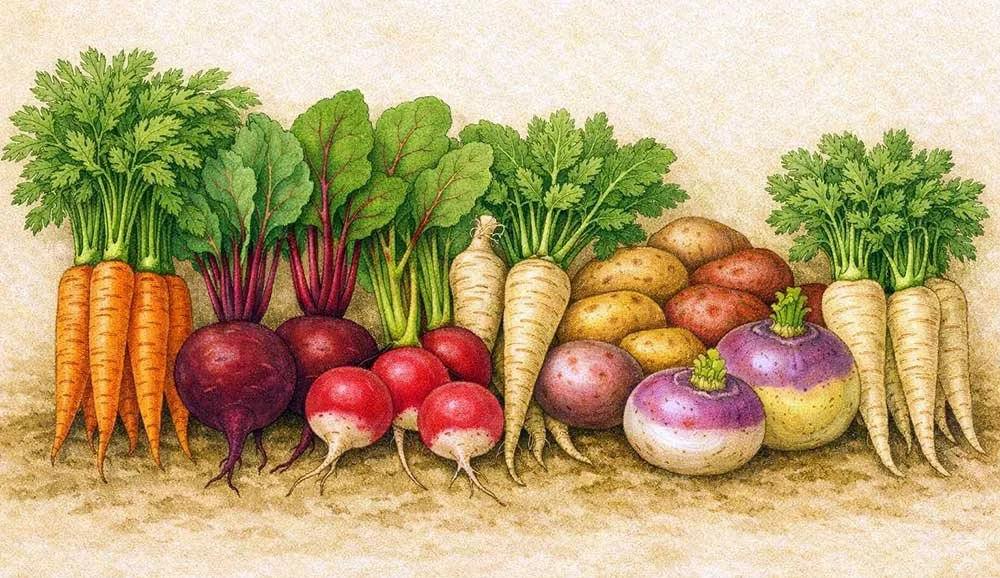
Root veggie rules: Carrots, beets, radishes, parsnips, turnips, sweet potatoes, potatoes and rutabagas play by different rules than everything else in your garden. The very richness that makes Deep Roots 100% compost great soil for tomatoes and above ground veggies works against root crops. High nutrients grow tiny roots. The good news: the fix is simple, and Deep Roots has made it even simpler by doing most of the prep work for you. Our blog posts on growing carrits, sweet potatoes and potatoes is comig soon. Learn more in our blog post on Growing Garlic, Onions and Alliums.
Roots store energy. Root crops aren’t trying to grow fast — they’re trying to store energy underground. Carrots, beets, radishes and parsnips only do that when they receive a specific signal that says “nutrients are present, but limited.” When nitrogen is too high — as it often is in manure-based compost — that signal never comes. Instead, the plant keeps putting all its plentiful energy into leaves. This is why gardeners sometimes see beautiful, bushy tops and disappointingly small roots. The plant is doing exactly what the soil chemistry is telling it to do.
Loamy & well-drained soil. The ideal soil is low-nutrient, loose organic sandy loam or potting soil. The pure compost Deep Roots uses as soil for above ground veggies lacks the mineral structure that root crops evolved in and holds too much water, dries unevenly, and encourages shallow or forked rooting. Also, don’t mix sand with sticky clumpy clay soil. The tiny particles of sand and clay bind together and change the soft clumps into very hard clumps.
PhoSul root crop fertilizer. When you test our free root fertilizser you become a member of our new root veggie method testing team. Just keep track of how many crops planted and the amound of the harvest . Take photos and weigh the harvested veggies. More details on PhoSul is below.
The solution: one dedicated root veggie bed
Root vegetables evolved in mineral soils with only modest organic matter. You don’t need to change your existing beds at all. Simply set up one dedicated root vegetable bed or large container with a low-nutrient soil. We are now testing difference blends of potting soil and sandy loam that will give roots exactly the growing environment they need. Reserve a separate container or area in your root veggie bed for the sifted soil carrots need.
Low nitrogen — Nitrogen is the plant nutrient that encourages leafy green growth. Root vegetables need some nitrogen, but too much can cause big tops and small roots. This soil is kept low in nitrogen so carrots, beets, parsnips, turnips and other root crops are encouraged to put more energy into the part you harvest: the root.
Mineral structure — “Mineral structure” means the soil contains the small mineral particles that give soil body and shape. Root vegetables need soil that is firm enough to support them, but loose enough for roots to push through. This helps carrots, beets, parsnips and turnips grow deeper, straighter and more evenly.
Low soluble salts — “Soluble salts” are minerals and nutrients dissolved in soil water. A little is normal, but too much can make it harder for young roots to take up water. This soil is designed to be low in soluble salts so roots can drink water more easily and expand without stress.
Good drainage — “Drainage” means how well extra water moves out of the soil. Root vegetables like steady moisture, but they do not like sitting in soggy soil. Good drainage helps prevent rotting, shallow growth and forked or twisted roots.
PhoSul: your new root veggie fertilizer
PhoSul is an OMRI-certified organic fertilizer made from rock phosphate and elemental sulfur. It contains no nitrogen. Phosphorus is the nutrient most responsible for root development in carrots, beets, parsnips, and turnips. PhoSul also releases calcium and silica as it breaks down, which gradually improves soil structure season after season. PhoSul fertilizerpurposefully incorporates sulfur to assist with nutrient release.
Build-and-maintain amendment: The best part is that PhoSul doesn’t leach out or the soil with water. Unlike nitrogen, which washes below the root zone every time you water, phosphorus bonds to soil particles and stays put. This means it builds a slow-releasing reserve your root crops can draw on all season long — without constant reapplication. Think of PhoSul as a build-and-maintain amendment, not a seasonal fertilizer you must continually renew. Instead, top it up lightly once a year, and over two to three seasons the bed will develop a stable phosphorus bank that works quietly beneath your root crops all season long.
To apply PhoSul: Put a pinch (1/8 teaspoon) of PhoSul in your planting hole for seedlings and seeds. It is very gentle and a little extra will not matter. When you buy our root soil, we will give you a small ziplock bag of PhoSul to add in at planting.
Carrots need loose soil without obstructions
Carrots need soil that is deep, loose and obstruction free to allow them to grow straight, large, and dense roots. To prevent forked and misshapen carrots, sift out wood chips, sticks, pebbles and other obstructions. Reserve a separate container or area in your root veggie bed for the sifted soil carrots need. Contact Deep Roots customer support to borrow our easy-to-use soil sifting tool that our carpenter created. Learn more in our blog post “Growing Carrots” (coming soon).
Garlic and Onions are NOT root crops
Garlic, onions, chives, leeks, shallots are alliums. It’s ideal soil and fertilizer has similarities to BOTH root veggies and above ground (fruiting and leafy) veggies. Garlic and other alliums require some nutrient rich compost in their soil, generous organic matter, and good nitrogen levels in early spring to grow large bulbs. The Deep Roots compost-rich beds your tomatoes thrive in are too nutrient-rich for garlic and cause tiny under-developed bulbs. Learn the details in our blog post Planting Garlic, Onions and Alliums.
Alliums need a soil blend: The solution is growing garlic and other alliums in their own bed or container using a soil blend of 30% Deep Roots high nutrient compost and 70% low nutrient potting soil. We like “Back to the Roots Organic All Purpose Potting MixPremium Blend”. Plant garlic cloves 22 inches deep in fall (late-October to mid November), apply a pinch of PhoSul fertilizer next to the clove and mulch with 2–4 inches of straw. In spring when seedlings reach 4–6 inches tall, top-dress (spread on all soil growing alliums) about a half inch of our compost. Harvest garlic when one-third to half of the leaves have browned.
Soil Blends for Potatoes and Sweet Potatoes
Like Alliums potatoes and sweet potatoes prefer well-drained low-nutrient loose topsoil, and DO NOT require large quantities of organic matter. Again “Back to the Roots Organic All Purpose Potting Mix” is a reliable choice. Over-fertilization tends to produce foliage instead of roots. A leaner nutrient soil is best.
Regular Potato Soil Blend: Mix 50% high-quality low-nutrient potting soil, 30% Deep Roots high-nutrient compost, 20% Deep Roots dense leaf mulch and potassium fertilizer like “Kelp Meal” or “Sulfate of Potash” Blend thoroughly, then fill beds or containers with loose, well-drained soil. This gives regular potatoes enough fertility without making the mix overly heavy. Learn the details in our blog post “Growing Potatoes” (coming soon).
Sweet Potato Soil Blend: Mix 5 parts low nutrient potting soil with 1 part nutrient-rich compost. Keep the blend light and only moderately fertile, since sweet potatoes produce better roots in leaner soil and too much nutrient richness can lead to excess vine growth. Learn the details in our blog post “Growing Sweet Potatoes” (coming soon).
Starting and Transplanting Root Vegetable Seedlings
Root vegetables that can be started indoors and transplanted include leeks, onions, and specifically "Clancy" variety potatoes, as they are less sensitive to root disturbance than others. Beets can sometimes be started indoors if transplanted very early, but most root crops like carrots, radishes, and parsnips are best direct-sown outside.
Root Vegetables for Indoor Starting
Leeks: Start 8-10 weeks before the last frost, as they handle transplanting well.
Onions: Can be started indoors 8-10 weeks early, with tops trimmed to 3 inches for stronger, transplant-ready plants.
Potatoes ('Clancy' variety): These can be started from seed indoors.
Beets: Generally better direct-sown, but can be started indoors and carefully separated if moved while small.
Why Most Root Crops Dislike Transplanting
Root vegetables develop a single taproot that is very sensitive to disturbance. Transplanting them often causes stunted, misshapen, or split roots. Tips for Success: Use biodegradable pots (like peat pots) to minimize root disturbance during the move to the garden. Ensure all plants are properly hardened off before moving them outside. For root crops that must be direct-sown (carrots, radishes, turnips), it is best to do so as soon as the soil can be worked.
What to expect
Learning to grow root crops is not a complicated change. Use dedicated beds or containers, filled with organic potting soil or a blend of potting soil and our compost. Everything else about your gardening stays the same. Your compost beds keep doing what they do best for tomatoes and greens. Your root veggie bed gets the low nutirent environment that finally lets carrots be carrots and beets be beets.
Plant something. Feed something. Protect something.
Deep Roots Project is here for every step of the journey.
“Grow Your Own Food” blog posts
See the full list of our Grow Your Own Food blog posts. Each post is assigned ”tags” which are under the post title. If you need a quick answer to a gardening question give us a call or send a text to our customer support team – support[at]deep-roots-project.org AND 708-655-5299.
Deep Roots online store
See our online store for details about prices, ordering and delivery of raised beds, planter boxes, microbe-rich compost, worm castings, leaf mulch and more. We don’t sell traditional soil, since we use 100% compost as our growing medium. Our online store has 2 sections – (1) raised beds and planter boxes and (2) compost, worm castings, fertilizer.
Please contact our customer support team before placing an order online so we can assist you with the details and answer your gardening questions. You can pay by credit card in the store or by check.
(708) 655-5299 and support[at]deep-roots-project.org
Sign up for our newsletter
Please leave your cell phone number when you sign up for our eNewsletter, if you want text message announcements now and then.
Donations help us provide organic kitchen gardening education to individuals, organizations, and entire communities. Thank you in advance for contributing to our community and for sharing our website and blog with friends and family.