
Watering, Moisture and Mulch
Different plants need different kinds of watering. Some veggies need more frequent and deeper watering than others. Seeds and seedlings need to be constantly moist. Although deep watering is best, over watering can also stress your plants, making good drainage essential. Of course, there will be a lot of variables to take into consideration – such as the amount of rain and other weather conditions. Do a simple moisture test with your finger on the top 2 to 4 inches of soil before you water. Be careful about the watering tips you see circulating on the internet or in YouTube videos!
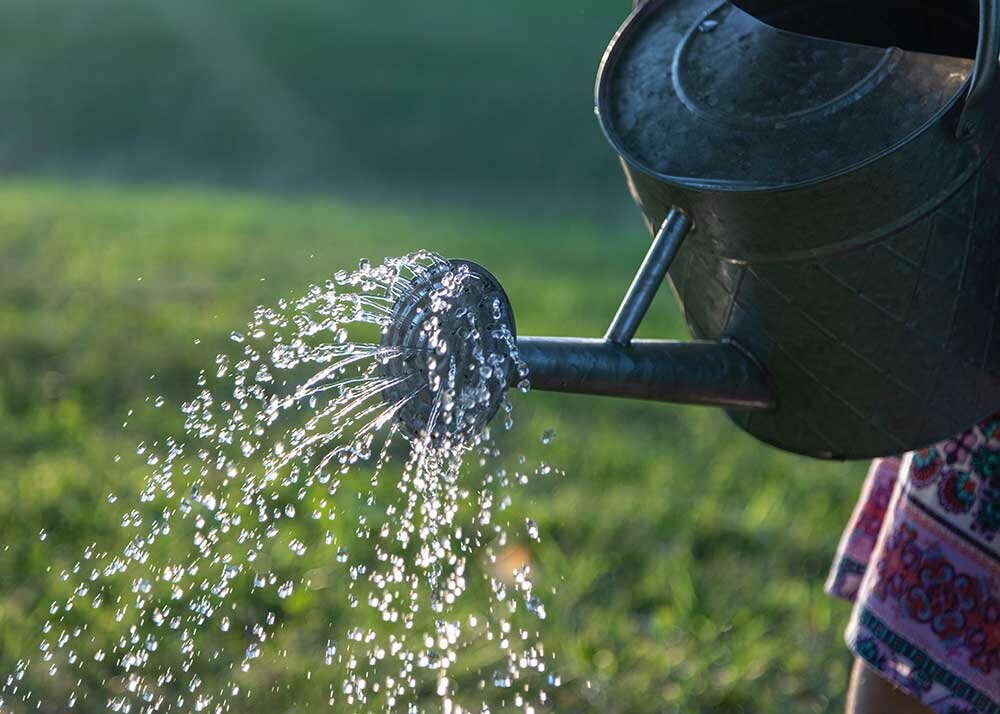
Proper watering is critical to plant health
Just as soil health depends on the latest soil science – the same is true of about watering edible plants. The Deep Roots method creates the best environment for your plants because our compost used as soil has good drainage and lets the water get to the plant roots quickly. We recommend installing drip irrigation if you don’t have time to water or go out of town often. Take time to correctly set the irrigation timing and amount. Past the seedling stage water deeply 2 or 3 times a week so the roots grow deep. Test soil moisture with your finger 2 to 3 inches down.
Cover soil with mulch.
Save water and time: Retaining as much moisture as possible saves watering time and keeps your plant healthy and happy. Plants grow faster and get bigger harvests if protected from temperature and dehydration. The two best options for mulching vegetable gardens are either a one inch layer of our organic leaf mulch, which you can purchase in our webstore, or organic straw mulch. Don’t use hay since it adds unwanted weed seeds to your garden. Never use any mulch that is not organic, as it could contain herbicides or pesticides which can ruin your garden and severely damage your plants.
Sourcing straw mulch can be a challenge. You can grow Miscanthus grass and allow it to overwinter, cutting it down in the fall. If you don’t have space for this, you may wish to purchase organic straw mulch from garden centers. Since certified organic straw mulch is hard to find, we recommend that you speak with local garden center owners to find out if the straw they sell is grown on farms that are functionally organic, even if they may not be certified. Once such center selling straw mulch from a local farm is The Feed Store, 5408 S. Harlem, Summit IL 60501, (708) 458-1327. Closed on Wednesdays.
Seed watering tips
When direct sowing seeds in your garden, keeping them moist is essential — peek under your mulch and if the soil looks and feels dry on the surface, go ahead and water. Daily is best, mornings are ideal. When you are planting in Deep Roots compost in raised beds or containers with good drainage, overwatering isn’t a big concern. However, if you are direct sowing in a growing medium or vessel that doesn’t drain well, you’ll need to be careful that your seeds don’t become waterlogged which can cause them to rot. Learn through observation the difference between soil that is moist, and waterlogged soil which is more like mud. You want moist soil, not soil soup.
If conditions are exceptionally hot, dry, or windy, check the soil moisture and consider a second light watering to prevent the soil from drying out. Water gently so you do not wash seeds out of place, and always check the soil before watering again. Raised beds and containers dry out faster than in-ground beds, so they usually need more frequent attention.
Transplanted seedlings watering tips
When you have just transplanted new seedlings into your garden, they should be kept moist consistently just like your direct sown seeds. Mulch around new seedlings and water whenever the soil under the mulch appears dry. If you are unsure, touch the surface. Keep up watering whenever the first inch or so is dry until you start to see new growth on the plant that wasn’t there when you transplanted it.
DON’T water mature plants a little everyday!
You have been watering daily early in the season as seeds are being sown and new seedlings are going into the garden. But once those plants are established, DON’T keep watering every day. It promotes shallow roots. One of the worst practices is to water your garden lightly every day or every few days. This frequent sprinkling provides water to only the top layer of the soil and promotes shallow root systems. Instead, water deeply whenever the top two inches of soil is dry.
Simple, standard suggestions like: water every day and “make sure you give your plants an inch of water each week” are now being questioned and re-evaluated. Because the plant’s roots are not close to the soil surface, we now know that the water needs to get deep enough and the roots need to have enough time to soak it up to allow the plants to develop deep root systems that are necessary to be healthy.
While overwatering, and waterlogging, can stress plants out, the risk of this is low if you are using Deep Roots compost as your growing medium and have a well-draining raised bed or vessel. If your vessels don’t have good drainage, or your not sure how well your soil drains, you should observe how long it takes your garden to drain after a heavy rain.
If top 2 inches of soil feels dry it’s time to water. Soak the soil to a depth of 4 to 6 inches. Test for soil moisture also after you water. It can take some time if you are watering with a hose, but it is worth it to do this deep watering less frequently to encourage root development.
Overhead watering (sprinklers) is the least efficient and least preferred method of watering. Far too much of the water is lost to evaporation, and the water tends to sit on the plants instead of making it to the soil, which can lead to fungal issues. Apply water directly to the soil, not the plants, with a soaker hose, drip irrigation, watering can or watering wand.
Watering tips from our horticulturist
Some conventional soils can have drainage problems, so too much water does not allow plant roots to breathe and will cause plants to wilt from lack of oxygen.
Don’t water too fast. Water gently at all times. When watering with a hose, avoid a hard stream of water, which risks injuring your plants and the soil. Use a steady, gentle shower of water instead – but only on the soil, not the plants.
If you are using municipal water, put a water filter on your hose or water source. Municipal water often has levels of chlorine that kill essential microorganisms. There are also many harmful pollutants in some city water. Chlorine filters used for RV water intakes are available online and can be connected directly to your hose.
Lack of water stresses plants. Drought may produce stunted fruit, produce no fruit at all, or may produce tasteless, woody, or unpalatable fruit.
Over watering stresses plants. Over watering can cause as much stress as severe drought. Too much water will saturate soils, displace air which starves the roots of oxygen. The compost Deep Roots used instead of conventional soil (Microbe Rich Compost) has good drainage properties.
Keep SEEDS moist at all times. Germinating seeds must be constantly moist. Watering seeds twice a day may be needed on dry hot days. It’s easiest to let drip irrigation water your seeds. Some gardeners without irrigation have found a work-around that saves time and constant attention.
Place a board or large tiles over tiny carrot seeds. This keeps the moisture in the soil longer, even longer than a standard mulch, and protects them from being washed away by heavy rain. Make note of how many days it takes for the first sign of germination. Check the seeds everyday when it is close to germination. Remove the cover when the first seed sprouts. Some seeds will sprout sooner and some later. Carrot seeds are very tiny and need to be kept constantly moisturized more carefully. Once you see them sprout, remove the board and add your mulch.
Keep SEEDLINGS moist at all times and water daily or more often for 2 weeks. When the seedling is at least 5 inches tall its roots are stronger and constant monitoring is not necessary. Test soil before and after watering and water gently and deeply as needed.
Don’t over water seeds! Finding the right amount of water for your seeds is difficult. Not enough and they will not germinate - BUT too much and they could rot. Just to be safe - water seeds lightly twice a day - you just need to moisten the top layer.
When plant leaves wilt on a very hot day, it could be from the heat and not lack of water. If you are following all the above tips, the wilting is likely from heat and not lack of water. In this case, try a shade clothe instead of more water.
Prune off lower foliage of plants prone to fungal diseases that prefer damp environments like powdery mildew on cucumbers and squash) and like tomato blights. Water very close to the soil with a watering wand on a hose or a watering can. Avoid wetting the leaves. Water early in the day
Health of mature plants is dependent on correct watering. Remember that large plants need a lot more water than seedlings. We want mature plants to have deeper roots that suck lots of water out of the soil.
A drip irrigation system nurtures healthier plants and less stressed gardeners. If you can’t or don’t want to water and monitor your soil moisture constantly get a drip irrigation system. Drip irrigation should be the watering method of choice. It will save you time and make your plants stronger, happier and healthier. The larger your garden the more critical drip irrigation becomes. Contact the Deep Roots team for advice on installing the new system we designed.Seed watering tips
Use our Planting Calendar blog posts for more useful seed starting tips like spring/ simmer/fall planting dates, soil temperature, temperature tolerances, direct seed vs transplants, seed depth, sunlight, and days to maturity. Choose from 9 planting calendar blog posts organized by crop group on our Planting Calendar and Climate blog category page: brassicas, cucurbits, fruiting crops, leafy greens, legumes, root crops, herbs, and berries.
“Grow Your Own Food” blog posts
Questions, comments, suggestions? We’d love to hear from you! Send photos of your garden too!
See the full list of our Grow Your Own Food blog posts. Our blog posts are divided into 6 categories – each with its own page of blog post photos and summaries.
Questions, comments, suggestions? We’d love to hear from you! If you need a quick answer to a gardening question give us a call or send a text. We are here to solve your gardening problems. Please call OR text our Customer Service team at 708-655-5299 OR send an email to: support@deep-roots-project.org.
Deep Roots online store
See our online store for details about prices, ordering and delivery of raised beds, planter boxes, microbe-rich compost, worm castings, leaf mulch and more. We don’t sell traditional soil, since we use 100% compost as our growing medium. Our online store has 2 sections – (1) raised beds and planter boxes and (2) compost, worm castings, fertilizer.
Please contact our customer support team before placing an order online so we can assist you with the details and answer your gardening questions. You can pay by credit card on the store or by check.
(708) 655-5299 and support[at]deep-roots-project.org
Gardening connects you to the Earth. Our community connects you to each other.
SIGN UP FOR OUR NEWSLETTER
(Use green rectangle and white type button style)
Please leave your cell phone number when you sign up for our eNewsletter, if you want text message announcements now and then.
Donations help us provide organic kitchen gardening education to individuals, organizations, and entire communities. Thank you in advance for contributing to our community and for sharing our website and blog with friends and family.