
The Soil Food Web
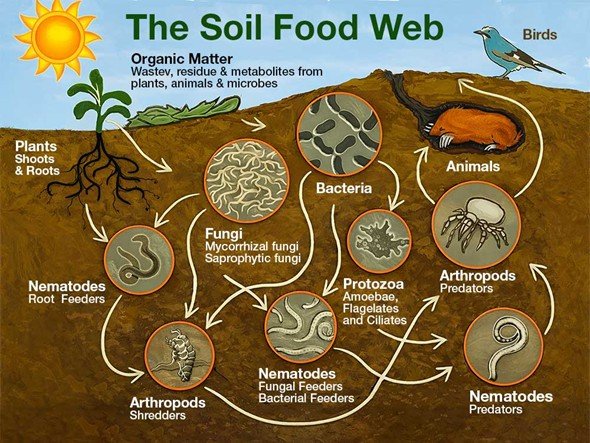
The Soil Food Web shows how soil life turns organic matter into plant nutrition. The chart arrows represent who eats whom—an essential process that releases nutrients, builds soil structure, and supports healthier plants.
The Garden’s Underground “Ecosystem”
Your garden has an underground “ecosystem” that grows healthy plants. When gardeners talk about “good soil,” they’re usually talking about living things—not dirt. Under every raised bed, herb patch, and flower border is a busy community of tiny living creatures that:
recycle organic matter into plant food
build crumbly structure that holds water and air
help roots access nutrients
reduce pest & disease problems by balancing the system
Our Soil Food Web chart shows the living community as a simple map of who-s-who in that web and how energy and nutrients move through it. Your garden soil is a kitchen, recycling center and immune system all in one. Plants “feed” the soil life, the soil life transforms scraps into nutrients, and the whole system supports stronger plants. The arrows show who eats whom (and therefore who releases nutrients in plant-available forms). That “eating” is a good thing. Plants don’t do this alone. They’re partners with microbes and tiny animals that process food, store it, and deliver it back to roots.
The Main Characters in the Soil Food Web
Plants: the food-web “solar panels”: Plants capture sunlight and turn it into sugars. A surprising amount of that energy goes down into the soil through as “root exudates” (tiny releases of sugars and compounds). Those exudates are like snacks and signals that recruit helpful microbes. Healthy roots = more food for soil life = better nutrient cycling.
Organic matter: the pantry for the whole system
Our chart describes organic matter as waste, residue, and metabolites from plants, animals, and microbes. Organic matter is not “just debris.” It’s the raw ingredient that becomes fertility. Think of organic matter as:
- leaves and plant pieces
- old roots
- compost
- mulch that breaks down
- natural residues that soil life can digestBacteria: tiny fast recyclers
Bacteria are microscopic workhorses. They’re especially good at breaking down “easier” materials (many fresh residues and simple compounds). They multiply quickly when there’s food and moisture. What bacteria do for gardeners:
- help convert organic matter into nutrients
- support aggregation (better soil structure)
- form the base of many food chains in soilFungi: the thread-like builders and root partners
There are two important fungal roles. Mycorrhizal fungi connect with roots and extend the root system’s reach. Saprophytic fungi break down tougher materials (often woody or fibrous). Fungi are also famous for building soil structure. Their thread-like bodies help form stable crumbs (“aggregates”) that improve drainage and water-holding at the same time. A simple gardener translation is ”Fungi help soil hold together in the good way.”Protozoa: microscopic “grazers” that release nutrients
Protozoa (amoebae, flagellates, ciliates) eat bacteria and other microbes. This grazing matters because it causes nutrient “release” in forms that plants can use. Think of protozoa as the compost-turners of the microscopic world—digesting and “making nutrients available.”Nematodes: tiny worms with different jobs
Nematodes get a mixed reputation because some types harm plants. Root-feeding nematodes are the ones gardeners don’t want in high numbers. There are also bacterial-feeders and fungal-feeders. Predatory nematodes eat other nematodes and help balance the system. In a balanced soil food web, the helpful nematodes and predators keep the community from tipping out of proportion. The goal is not “no nematodes.” The goal is a balanced community.Arthropods: shredders and predators
“Arthropods” is a big category that includes many soil-dwellers (mites, springtails, beetle larvae, and more). Shredders chew and break organic matter into smaller pieces making it easier for microbes to finish the job. Predators:hunt other soil organisms, keeping populations balanced. Gardeners benefit because shredding speeds decomposition and predators reduce boom-and-bust outbreaks.Larger animals and birds: the top of the web
At the top of your chart are larger animals (and birds). These are the visible members of the system that feed on arthropods and other creatures. Their activity is often a sign of a living, functioning soil habitat.Better nutrient delivery without “force-feeding”
In a living soil, nutrients cycle through bodies—microbes eat, get eaten, and nutrients become available near roots. This is gentler and steadier than trying to force growth with quick, salt-based chemical fertilizers.
Stronger plants with fewer problems: A diverse soil community creates competition and balance. Many plant diseases struggle to dominate in a biologically active, diverse soil ecosystem.
Soil structure that makes gardening easier. When the soil food web is thriving, you tend to see more crumbly texture, better water infiltration, less crusting / compaction and improved root growth.
Feed the web with the right kind of fertility
The Deep Roots approach is feed the soil, and the soil feeds the plants. We focus on microbe- and nutrient-rich compost and high-quality worm castings because they don’t just “add nutrients”—they support the living system that manages nutrients.
Is compost enough? Quality matters. Compost that is rich in microbial life and made well can be a powerful foundation. Deep Roots emphasizes compost and castings because they support both nutrients and biology—and biology is what keeps the system resilient.
Keep the habitat friendly. Soil life needs:
oxygen (not compaction)
moisture (not constant drying and flooding cycles)
food (organic matter and root exudates)
protection (less disturbance)
Where fish emulsion fits: Worm castings are our steady, soil-building base. Fish emulsion is our targeted helper when plants need a quick, gentle boost—especially early growth, transplant recovery, or when a plant looks pale and needs nitrogen support. Used correctly, fish emulsion can complement the soil food web because it’s typically less harsh than many synthetic salts and works best as a support, not as the entire fertility plan. Use fish emulsion like a vitamin—helpful when needed—while compost and castings remain the daily food that keeps the whole system strong.
Avoid practices that wipe out your workforce
“Chemical fertilizers” can work short-term but weaken the system long-term. Many fast-release synthetic fertilizers are designed to feed the plant directly—often with a strong “salt” effect. That can lead to a cycle where plants grow quickly, but soil biology gets less support.
Here’s what commonly goes wrong:
The soil food web gets bypassed. Plants may send fewer root exudates (less “food” to microbes), which can reduce microbial diversity over time.
Salt stress can harm roots and microbes. High concentrations can burn roots, reduce microbial activity, and make watering harder to manage.
Growth can become soft and pest-prone. Fast nitrogen pushes lush foliage that is often more attractive to pests and more vulnerable to disease.
Soil doesn’t improve. Synthetic fertilizers don’t build organic matter or structure, so you can get growth without getting better soil.
This doesn’t mean a gardener is “bad” for ever using them—it just explains why Deep Roots focuses on building fertility through biology.
Healthier plants with fewer problems
Don’t just “feed the plant,” feed the living system underneath it that turns organic matter into abundance. The soil food web is the everyday story of how sunlight becomes food—not just for plants, but for everything that depends on plants (which is… all of us). It’s the living, underground network that connects roots, microbes, tiny soil animals, and the creatures above ground that depend on them.
…and a heathier planet
When the soil food web is healthy, it does far more than “grow bigger plants.” It helps restore soil health, increase biodiversity, build larger and more active microbe populations, store carbon underground, and improve the nutritional quality of the food we grow. Healthy soil is one of the strongest foundations we have for a stable garden—and a healthier planet.
Join the Deep Roots movement
We’re not just about gardening; we’re about changing the way people grow food. Whether you have a tiny balcony or a full backyard, we’ll help you grow like a pro.
Stay in the loop: Signup for our email newsletter. If you also provide your phone number you will get text message updates that link to our best blog posts.
Get involved: Attend a free workshop, become a volunteer, grab a raised bed, or simply follow along for expert tips. Contact our support team any time you have a question at 708-655-5299 and support@deep-roots-project.org.
Learn. Share. Grow. Volunteer: We invite you to be a part of our sustainable movement right here in our own backyards! We want all our volunteers to have fun and learn while they contribute to expanding the Deep Roots community. We can customize a volunteer assignment to your time, interests and skills. Learn more on our Volunteer page
Dive Deeper
Click on the Blog Posts below for more about our Innovative methods.
Beautify Your Garden with Our Cedar Raised Beds!
Our Deep Roots handcrafted cedar raised beds are designed to endure outdoors while adding a touch of style to your yard. As a bonus, they are the perfect depth to hold just the right amount of our nutrient-rich compost growing medium, which comes free with each bed.
Deep Roots Supports Gardeners
We provide our gardeners with the best products for success – like cedar raised beds, microbe-rich compost and microbe-rich worm castings.
Call our customer support team with any questions or help with calculations. Then place your order online. If you need help or have a question contact us at support[at]deep-roots-project.org and 708-655-5299.
See our online store for details about prices, ordering and delivery of raised beds, planter boxes, microbe-rich compost, worm castings, leaf mulch and more. We don’t sell traditional soil, since we use 100% compost as our growing medium. Our online store has 2 sections
Signup for Our Newsletter
Please leave your cell phone number when you sign up for our eNewsletter to get gardening and seasonal text messages announcements now and then.
Donations help us provide organic kitchen gardening education to individuals, organizations, and entire communities. Thank you in advance for contributing to our community and for sharing our website and blog with friends and family.